
Can a Birth Chart Calculator Predict Your Future? Can Astrology Accurately Predict the Future?
A reader types a birth date, a time and a city into a calculator, and a wheel of symbols appears. Then the big question hits: can it predict the future? Some sites promise wedding dates and dream jobs, while others call the whole thing nonsense and show no proof. This guide separates what the tool computes, what an astrologer reads, and what tests found.
Can a Birth Chart Predict Your Future? The Short Answer
No. A birth chart cannot predict the future. It records the sky at a person’s birth, and tests of astrology’s bigger claims have not backed it up.
The chart tool handles the first step, which is astronomy. An astrologer handles the second step, which is interpretation, and neither step adds proof. Readers type “can a chart predict your future” for a good reason: the answer decides how much weight they give the result.
| Job | What the tool does | What a prediction needs |
|---|---|---|
| Positions | Computes the sign and degree of each body | Nothing extra, this part is astronomy |
| Houses and rising sign | Computes them from the time and place of birth | An exact birth time |
| Meaning | Gives a short text for each placement | An astrologer’s judgment |
| Timing | Shows no dates ahead | A method such as transits, which compare today’s sky with the person’s placements |
| Proof | Cannot show that a forecast came true | A written prediction, a date window, and a result anyone can check |
This guide’s view: a reading works best as a prompt for reflection. Any dated forecast is a claim that needs a test.
What Does a Birth Chart Calculator Actually Calculate?
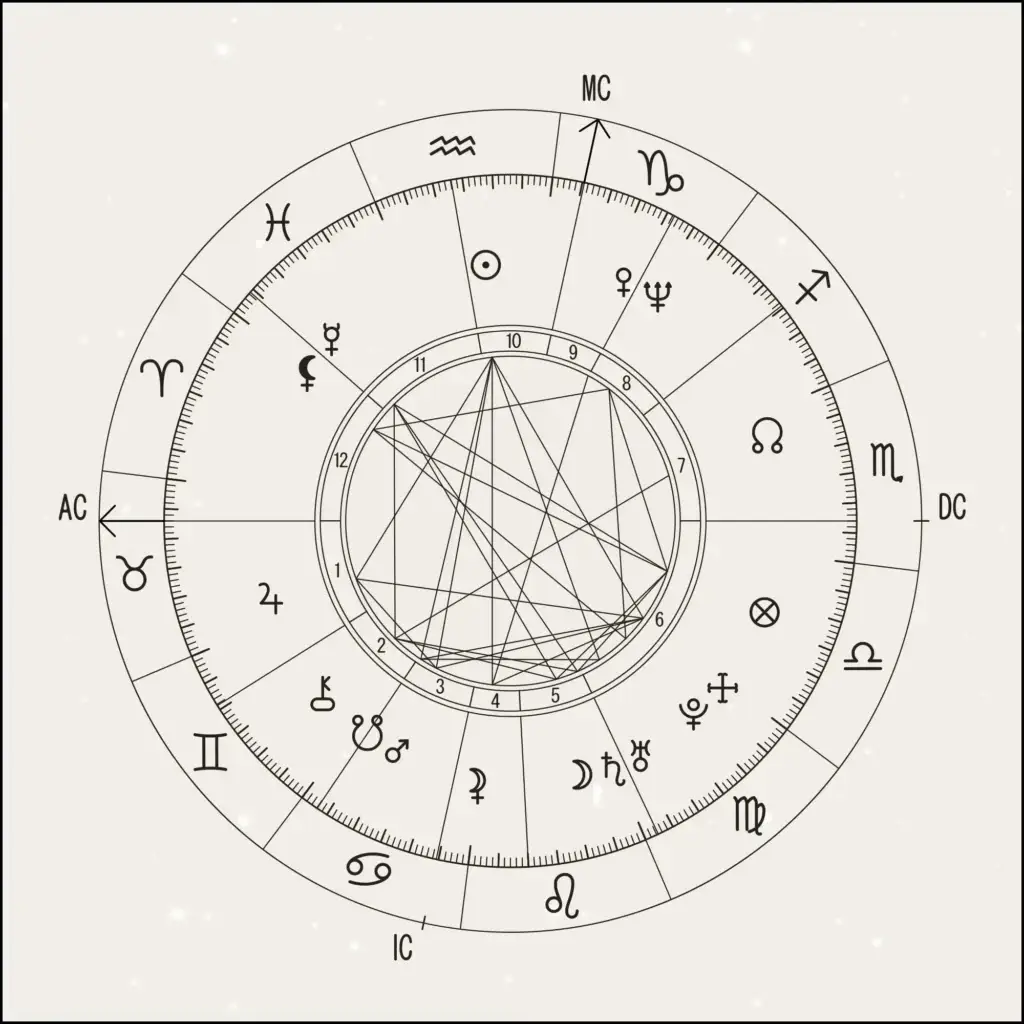
It calculates where the Sun, Moon and planets sat in the sky at the moment a baby arrives. It needs a date of birth, a time of birth and a birthplace. The result is a snapshot of the past, so it holds no dates ahead.
Astronomy tracks the stars and planets, and software now does that math in a blink. Astronomers used to predict body positions from printed tables, and the same math sits inside every such tool. Astrology adds a second layer: it places each of the celestial bodies in a zodiac sign and a house, then assigns meaning. The math behind the result shows each step.
Each of the 12 astrological houses covers an area of life. The 3rd house covers siblings and short trips. The 4th house covers home, the 5th house covers romance, and the 10th house covers career. The 12 houses guide lists the rest.
It also shows a sun sign, a moon sign and a rising sign (how the big three differ). Aspects appear too, which are angles such as a Moon square Mars, where the two sit 90 degrees apart. Each planet aspecting another gets a short note, and none of those notes carries a date for future events.
How Do Astrologers Use a Birth Chart to Predict Events?
Astrologers use birth charts as a base, then compare them with where the bodies stand at another time. The main timing methods are transits, progressions, solar returns and dashas. Astrologers say these methods predict events. Each one claims to show when a life event may start.
| Method | What it tracks | Typical claim |
|---|---|---|
| Transit | Today’s sky against the baseline placements | “A slow planet crosses the house of work, so pressure rises” |
| Progression | One day of motion stands for one year of life | “The progressed Moon shifts the focus” |
| Solar return | A new reading for each moment the Sun returns to its starting spot | “This reading describes the next 12 months” |
| Dasha (Vedic) | Planetary periods that start from the Moon’s placement | “Each period marks the themes likely to occur” |
Astrologers call the sky’s current pattern “astrological weather,” and a transit reading compares that weather with the natal chart. Astrologers make predictions in broad terms, and predictions based on transits sound like “a busy stretch for work.”
An astrologer might add that the method is able to predict themes, not exact days. Chris Brennan, host of The Astrology Podcast, says a transit can signal an experience before the details show up:
“you may not know the context yet because you don’t know what specific job you’re gonna be having.”
Source: The Astrology Podcast, Ep. 365 transcript
Even a working practitioner describes the method as pointing at themes, not at a specific life event or a date. Readers can hold other forecasts to the same bar.
Vedic astrology uses the sidereal zodiac and a chart that it calls a kundli. It counts 9 planets, which it calls grahas. These include Rahu and Ketu, two points where the Moon’s orbit crosses the Sun’s path, and readers of that system treat both as karmic. Western astrology uses the tropical zodiac instead.
Two systems can give one person two different forecasts, so chart readers can disagree on timing. How the two systems differ covers the setup, and how to read a chart covers the parts both share.
Can Astrology Accurately Predict the Future? What Tests Found
No test has shown that astrology accurately predicts events. The best known controlled test came from physicist Shawn Carlson, who published it in Nature in 1985. Astrologers in that double blind study could not match a person’s astrological chart to that person better than chance.
A double blind design hides the answers from everyone who could nudge the result. Astrology makes broad claims, so the fair test asks one thing: does astrology predict better than a coin flip? Carlson tested personality matches, not event forecasts, but the same reading sits behind both claims. This guide found no controlled study that shows event forecasts beating chance.
Belief stays common. The Pew Research Center reported in 2025:
“30% of U.S. adults say they consult astrology (or a horoscope), tarot cards or a fortune teller at least once a year.”
Source: Pew Research Center, May 2025
The same survey found 27% of adults believe in astrology, and 20% use these practices mainly for fun. Only 1% rely on them a lot for major life decisions, and 5% rely on them a little. Tarot and numerology make similar prediction claims and face the same testing problem.
Can a Birth Chart Predict Your Marriage?
No. A chart cannot say if or when anyone will marry. Tradition points to Venus, Jupiter and the house of romance, but the claims often match what is already common.
Take the popular forecast of a wedding “after 28.” The US Census Bureau reports median first marriage ages of 30.8 for men and 28.4 for women in 2025 (Census Bureau release, December 2025). That forecast fits both medians, so it fits most adults. In 1975, the medians sat at 23.5 for men and 21.1 for women, so era matters as much as any forecast.
Jupiter circles the Sun in about 12 years and changes sign about once a year. A forecast tied to that move therefore covers a full year, which is a wide net. Brennan adds that such readings “may not make as much sense if you’re attempting to look at something like 50 years in the future.” Astrology cannot pick a wedding year, and a reader who hears a specific date should ask for the method behind it.
Can a Birth Chart Predict Your Career?
No. A chart cannot name a career or the year a person will change jobs. Tradition points to the house of work and Saturn, but skills and interests decide job fit.
The two main systems read different clues.
| Check | Western astrology | Vedic astrology |
|---|---|---|
| Main house | The house of work and the Midheaven | The same house and its ruler |
| Key points | Saturn and the Sun | The Sun and the lord of that house |
| Timing | Transits and progressions | Dashas and transits |
| Typical output | Themes of ambition and status | Job types and promotion periods |
Job changes happen often enough to make forecasts look good. The Bureau of Labor Statistics reports a median job tenure of 4.1 years in January 2026 (BLS employee tenure release). A forecast of a job change in any four year stretch fits many workers.
The ringed giant adds another trap. It circles the Sun in about 29.5 years, so astrologers talk about a Saturn return near age 29.
This guide ran a test with the open source astronomy engine library. In it, 58.7% of people got one exact return hit, and 41.3% got three. The giant appears to move backward and then forward over the same point. The first exact hit fell between ages 28.4 and 29.9.
A better first step for career choices is an interest test. The O*NET Interest Profiler comes free from the US Department of Labor. It matches answers to 6 interest areas and links to more than 900 occupations. It measures fit with questions, so a reader can check the result against real life, and career potential comes from what a person likes and does well.
Why Do Astrology Predictions Feel So Accurate?
They feel accurate because many statements fit almost everyone, and readers remember the hits. Psychologists call this the Forer effect, also known as the Barnum effect. People who say astrology works often cite personal hits.
Four habits make a reading feel personal:
- Broad wording: “Wants approval, yet values personal space” fits most people.
- Hindsight: A reader matches a vague forecast to an event after it happens.
- Selective memory: Hits stick, and misses fade.
- Gap filling: A reader adds details from real life to a general line.
Free horoscope charts and daily horoscope text both lean on broad wording. A daily horoscope covers one zodiac sign, which is one twelfth of all people, so it must stay general. Many reports claim to rest on data “based on your birth,” yet the same lines can fit millions of readers. How reliable these results are shows how to judge a result, and chart, horoscope and natal chart differences separates the three terms.
How Can a Reader Test a Birth Chart Prediction?
Write the prediction down with a date window, then compare the result with how common the event is. This turns a feeling into a test.
- Write it down. State the event, the person and the dates. “A big change at work between March and June” works, and “change is coming” does not.
- Set a window. Pick a start and an end date before the period begins.
- Record the result. Note what happened, even when the forecast missed.
- Check the base rate. Ask how often that event happens to most people in a window like that.
Readers can test any forecast based on their birth data this way. Features carry base rates too. This guide’s test used 25,000 random moments between 1950 and 2010. It used the tropical zodiac and 10 bodies, from the Sun through Pluto plus the Moon.
| Feature | Share of people born with it |
|---|---|
| 3 or more bodies in one sign | 68.4% |
| 4 or more in one sign | 20.7% |
| 5 or more in one sign | 4.1% |
| Mercury retrograde | 19.1% |
| Mars moving backward | 9.4% |
| Sun and Moon in the same sign | 8.4% |
| No body moving backward | 10.6% |
Many readers treat a pile of bodies in one sign as special, yet three in one sign is the norm. A person with an Aries Sun, a Gemini Moon and Virgo rising sounds distinctive. So does one with Capricorn, Libra and Pisces placements and Mars in Sagittarius, but features alone do not make a placement unusual. All seven classical planets in one element is rare, at 0.07% of people.
Does Birth Time Change a Prediction?
Yes. A wrong hour can move the rising sign and the house placements, and timing methods depend on both.
The rising sign changes about once every two hours and moves roughly 1 degree every 4 minutes on average. A few minutes can shift a house cusp, and an hour can change the whole set of houses. The Moon moves about 13 degrees a day and changes sign every two to three days, so the date matters too.
- Stays stable: the Sun’s sign, most other signs, aspects between slow bodies
- Can change: the rising sign, house placements, the Moon’s degree near a sign change
- Needs the exact time: any transit through a house
Readers who lack an hour can try a reading without an exact time. A result that looks off needs a check, and fixing wrong results walks through it. The chart tool takes any hour a reader enters, so the quality of that input sets the quality of the result.
Can AI Predict the Future Better Than an Astrologer?
No. AI explains a chart in plain words, but it adds no evidence that the reading works as a forecast. AI writes fast, and speed does not make a forecast more accurate.
Positions should come from a tool that uses astronomy data. AI works best for explaining terms such as aspects and houses, not for naming dates. Whether AI will replace human astrologers is a market question, not an evidence question. The evidence question stays the same for both: does the forecast beat chance?
Frequently Asked Questions
Can your birth chart predict your future?
No. A chart shows the sky when a person is born, and tradition reads it as tendencies. The best known controlled test found no match between readings and personalities beyond chance.
Who is the fakest zodiac sign?
No sign is fake. All twelve come from the same system, and each covers 30 degrees of the sky. People joke about certain signs, but no test ranks one as less real.
What can a birth chart tell you about your life?
A chart gives a symbolic description of the sky when the person was born. Readers use it for personality themes and parts of a person’s life, such as work and love. It names no events or dates.
Can AI analyze my birth chart, and is it accurate?
AI can explain a chart that a reader supplies. The positions should come from an astronomy based tool, because AI can make math errors. The explanation works as a summary, not a forecast.
What are the limitations of a birth chart calculator?
It needs a correct date, hour and place. Settings such as house system and zodiac type change the result. It also gives no proof that a reading is true.
What if I don’t know my exact birth time?
The Sun’s sign and most other signs still show up. The rising sign and houses need the hour. Family records or a hospital record can help.
How is a personalized astrology reading different from a daily horoscope?
A personalized reading uses the full chart, with every body, houses and aspects. A daily horoscope uses only the sign of the Sun, so it stays broad enough for one twelfth of people.
Will AI replace human astrologers in the future?
Nobody can say. AI already writes readings quickly, while some people still want a human astrologer. Neither one shows that astrology really predicts events.
Key Takeaway
A chart describes the sky when a person is born, and it does not say what comes next.
- A chart tool computes positions and gives no dates ahead.
- Tests of astrology, including a 1985 study in Nature, found no match beyond chance.
- Any forecast improves with a written date window and a base rate check.