
How Does a Birth Chart Calculator Work? A Natal Chart & Sun Sign Guide
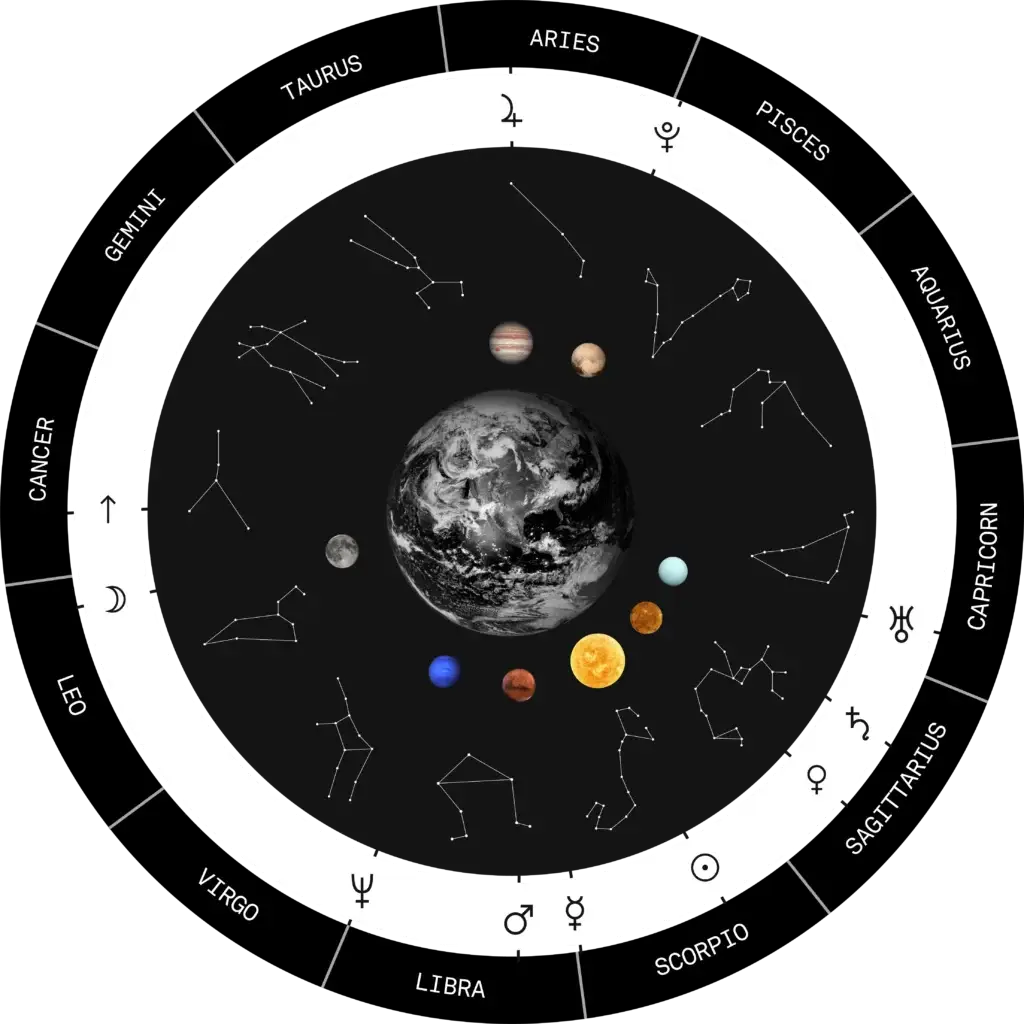
A birth chart calculator works by turning a birth date, time, and location into a map of the sky. It puts the sun, moon, and every planet right where they stood at the moment someone was born. This map becomes a natal chart, showing where the important points fall. The calculation stays accurate no matter how often it runs, since it runs on real astronomical data.
What Is a Birth Chart Calculator?
A birth chart calculator is a tool that turns birth details into a map of the sky. Someone enters a birth date, time, and location, and the tool works out where the sun, moon, and other planets sat at that moment. The result is a natal chart, also called a birth chart. Both names describe the same thing, a snapshot of the sky at the moment someone was born.
Astrology uses this snapshot to explain character traits, emotional patterns, and life themes. A calculator does not guess or estimate anything. It runs on verified astronomical data, the same method professional astrologers use by hand.
What Information Do You Need to Calculate a Birth Chart?
Calculating a birth chart needs three pieces of information: a birth date, birth time, and birth place. Each one plays a different role in the final result. The date sets the sun’s position and most other points. The exact birth time decides the rising position and the houses.
A calculator cannot fill in a missing piece on its own. Skip it, and the rising position and houses turn into rough estimates instead of fixed points. Skip the location, and the entire chart can shift, since even a nearby city can change the result.
The table below shows what each input controls and what happens when it is missing or wrong.
| Birth Input | What It Determines | What Happens If Missing or Wrong |
| Birth date | Sun position and most other points | Wrong date shifts nearly every point in the chart |
| Birth time | Rising position, house positions, precise moon position | A missing one leaves the rising position and houses unknown |
| Birth location | House lines and rising position | Wrong city or time zone can shift the entire chart |
How Does a Birth Chart Calculator Actually Work?
A birth chart calculator works by pulling data from an ephemeris, a large table that records the position of every point for any date in history. It looks up the birth date and time in that table, then converts the result into positions, degrees, and houses. This process runs the same way every run, since the numbers behind it are fixed astronomical facts, not opinions.
NASA’s own JPL Horizons ephemeris system shows how this kind of lookup works at a professional level, tracking the position of every major body in the solar system for any date in history. A calculator runs on the same basic principle, just scaled down to the handful of bodies astrology tracks.
Think of an ephemeris like a very detailed calendar of the sky. Instead of tracking holidays, it tracks where every point stood on every single day going back centuries. A calculator just looks up the birth moment on that calendar and reads off the positions.
Once the calculator has these positions, it still needs to sort them into houses. This step uses the birth time and city to work out where the horizon and midheaven fall, then applies a house system to divide the sky into twelve parts. Most calculators default to a system called Placidus, mostly because early astrology software was built around it decades ago, and later tools simply kept using that same standard rather than picking it for accuracy.
What Does a Birth Chart Calculator Show You?
A birth chart calculator shows three layers of information: the points that shape someone’s character, the zodiac position each one sits in, and the area of life each one affects. Together, these three layers explain what part of someone is active, how it behaves, and where it shows up in daily life.
Each point in the chart represents a different part of who someone is. One point shapes core identity, another shapes communication style, and others shape love, drive, or emotion.
The zodiac position a point sits in changes how that part behaves. The same point can act bold and fast in one zodiac area, then feel slower and more careful in another.
The house a point falls in shows where in life it plays out. A point in the career house shows up at work, while the same point in the relationship house shows up with partners.
The table below breaks down what each layer means and gives an example of each one.
| Layer | What It Means | Example |
| The points | What part of someone is active | Identity, communication, love, drive |
| The zodiac position | How that part behaves | Bold and fast, or slow and careful |
| The house | Where in life it shows up | Career, home, relationships |
Sun, Moon, and Rising Sign: Your Big Three Explained
The Big Three are the three points that shape most of someone’s character: core identity, emotional side, and the impression made on others at first meeting. Together, they give the fastest, clearest snapshot of who someone is in a chart.
Most people start reading results here, since these three points carry the most detail of anything in the chart. One shapes who someone is underneath, one shapes how someone feels day to day, and one shapes the first impression given to new people.
Reading these three together works better than reading them apart, since they often blend into one overall picture. For a full breakdown of what each position means and how they combine, see the complete Big Three guide.
Do All Birth Chart Calculators Use the Same House System?
No, calculators do not all use the same house system. Most default to a method called Placidus, but some use Whole Sign instead, and a few let users choose.
In astrology, the house system decides which house each point falls into, not where it sits in the sky. Two tools can agree completely on every point’s position, then still disagree on which house each one lands in, simply because they divide the chart differently.
Placidus runs into a real limit near the poles. Above 66 degrees and 33 minutes north or south latitude, the math behind it stops working, since it depends on a point rising and setting within a single day, something that does not happen for weeks at a stretch that far north or south. This figure comes from Astrodienst’s own technical documentation on the Placidus house system, one of the most established references in astrology software.
April Elliott Kent, a practicing astrologer with more than three decades of experience, has pointed out that many astrologers simply pick whichever house system produces a result they like best, rather than treating one method as more correct than the rest. This is a reasonable way to think about the choice, since no house system has been proven more accurate than another.
For readers without a confirmed birth time, Whole Sign tends to be the safer default, since its houses stay fixed to a full zodiac area and shift less from small timing errors than Placidus does.
The table below compares four common house systems and how each one divides a chart. For a deeper look at how each system divides the houses, see the complete 12 Houses in Astrology guide.
| House System | How It Divides | Best For |
| Placidus | Uses time to create houses of different sizes | Most common default, works outside polar regions |
| Whole Sign | Matches each house to one full zodiac area | Any location, including far north or south |
| Koch | Similar to Placidus but starts from a different point | Popular among some Western practitioners |
| Equal | Every house is always 30 degrees wide | Simple and reliable when birth time is uncertain |
Do Birth Chart Calculators Use Real Time Zones?
Yes, calculators use real time zones, pulling from historical records to work out what time it actually was in a city on any given date.
Time zone rules have changed repeatedly over the decades, especially before 1970. A city may have followed a different daylight saving schedule decades ago than it does today, so a calculator has to know the rules in effect on that specific date, not just the rules that apply today.
Most tools pull this historical data from the IANA Time Zone Database, a shared reference many calculators rely on to work out the correct offset for a given date and city. In the United States, the Uniform Time Act of 1966 standardized daylight saving dates nationwide, though individual states and cities had already been keeping their own local rules for years before that law took effect.
This is not just a historical footnote. Anyone entering a birth date from the 1940s or earlier should expect the recorded time zone to differ from what a modern city uses today, since local governments handled these rules independently before national standardization.
For a deeper look at how these settings affect chart accuracy, see the full breakdown in the complete trust and reliability guide.
A Worked Example: Watching One Planet Change Houses
A single point in a chart can land in a completely different house if the house system changes, even though its position in the sky stays the same.
Imagine a point sitting at 2 degrees of Aries in a chart. Under Placidus, that point lands in the fourth house, the area tied to home and family. Under Koch, using the same birth details, the same point can land in the seventh house instead, the area tied to partnerships.
Nothing about the point moved. Only the dividing lines changed, since each house system draws those lines differently. This is why two calculators can show the same point in two different areas of life, without either one being wrong.
This differs from a birth time error. The complete guide to charts without a confirmed birth time covers that case in full. Here, the same birth date, birth time, and city produce two different results, purely because the house system changed, not because any input was wrong.
The table below shows how one point shifts between two common house systems.
| House System | Point’s House | Life Area |
| Placidus | Fourth house | Home and family |
| Koch | Seventh house | Partnerships |
Is Astrology 100% Accurate?
No, astrology is not 100% accurate in the way many people expect, since the math and the meaning behind it are two separate things.
The math behind a chart is precise. Real astronomical data puts every point right where it stood in the sky, and that part does not change no matter who reads the results.
The meaning behind those positions works differently. Reading a chart involves judgment, since symbols can be read more than one way. Two astrologers can look at the same accurate chart for one person and highlight different themes, and neither one is wrong.
Steven Forrest, an astrologer who has written and lectured on the subject for decades, has described this side of the work as closer to art than to strict calculation, since the technical part takes real study, while the actual reading of a chart comes down to interpreting a symbol. That framing helps explain why two accurate readings of the same chart can still sound different.
This distinction matters for anyone comparing astrology to a science. The numbers behind a chart hold up to real verification, but the interpretation stays symbolic, not something that can be proven true or false the way a math problem can.
Can AI Tools Like ChatGPT Accurately Explain a Birth Chart?
No, AI tools like ChatGPT cannot accurately explain a chart on their own, since they cannot calculate one. They can only describe results that a real calculator already produced.
A language model works with text, not astronomical data. It has no access to an ephemeris, so it cannot work out where a point actually stood in the sky at a given moment. Ask it directly for positions without giving it real results, and it will guess based on patterns in its training data, not real positions.
This does not mean AI is useless here. Once a real calculator produces results, an AI tool can help explain what those results generally mean, in plain language. The accuracy still depends entirely on the calculator that ran first, not on the AI itself.
Anyone using an AI tool this way should paste in the actual results from a trusted calculator, rather than asking the AI to work out positions from scratch. This keeps the math correct while still getting a clear explanation of what it means.
How to Read Your Birth Chart Calculator Results
Reading results works best in order: start with the Big Three, then move into the houses, and check any aspects last. This order builds understanding step by step instead of overwhelming a reader with every point at once.
- Start with the Big Three. These are the three points that carry the biggest impact: core identity, emotional side, and the first impression given to new people. They set the overall tone for everything else in the chart.
- Move to the houses. Each one shows where a point plays out in daily life, whether that is career, relationships, or home. This step turns abstract traits into real areas of life.
- Check the aspects. These show how different sides of someone’s character support or challenge each other, adding depth once the basics make sense.
Anyone ready to see their own results can run their details through the calculator, then come back to walk through each layer using the steps above.
Frequently Asked Questions
The FAQ section below answers the most common questions readers search for after running a calculator, covering required inputs, chart layers, tool selection, and AI limitations.
What information is needed to calculate a birth chart?
Calculating a chart needs three inputs: a date, a time, and a location. The date sets most points, that input decides the rising point and houses, and the location keeps the house lines accurate for that specific spot on Earth.
What is the difference between planets, signs, and houses in a birth chart?
Points show what part of someone is active, the zodiac area shows how that part behaves, and the house shows where in life it shows up. A chart uses all three layers together, since none of them tells the full story on its own.
What is considered a lucky placement in a birth chart?
Many astrologers point to Jupiter in a strong position as one of the more fortunate points in a chart, since it traditionally lines up with growth and opportunity. This is a common view, not a guaranteed outcome, since a chart works more like a set of tendencies than a fixed promise. No single point decides anyone’s luck on its own.
What are the best apps or tools for calculating a natal chart?
The best tools rely on a real ephemeris and clearly state which house system they use by default. Look for a calculator that lets users switch between systems and shows results with clear dates and coordinates that can be double checked. Avoid free tools that hide their settings or skip key birth details entirely, since accuracy depends on getting those details right.
Can ChatGPT explain my birth chart?
ChatGPT and similar tools can explain general meanings once real results exist, but they cannot calculate those results from scratch. Paste in output from a trusted calculator first, then ask for an explanation. This keeps the math accurate while still getting a clear, plain language answer.
How do you read or interpret a birth chart?
Start with the Big Three, then move into the houses, then check the aspects between points. This order builds a clear picture step by step instead of throwing every detail at a reader at once. For a deeper walkthrough, see the complete How to Read a Chart guide.
Key Takeaways
A calculator turns birth details into a chart of the sky, and that math stays reliable no matter which tool runs it. What changes between tools is not the data behind it, but choices like which house system it uses and how it handles historical clock changes.
None of these differences make a chart wrong, they simply reflect different valid settings. The house system decides where a point lands, not whether the underlying math is correct.
The newest wrinkle is AI. A language model can explain what a chart means, but only after a real calculator has already done the math first, since it cannot work out sky positions on its own.
Trust the math behind any set of results, then treat the reading itself as a starting point for reflection, not a fixed answer.