
How to Read Your Birth Chart Calculator Results (Step by Step)
A chart calculator result makes sense once read in the right order. The Sun, Moon, and first impression point come first, followed by the planets, signs, houses, and aspects, one at a time.
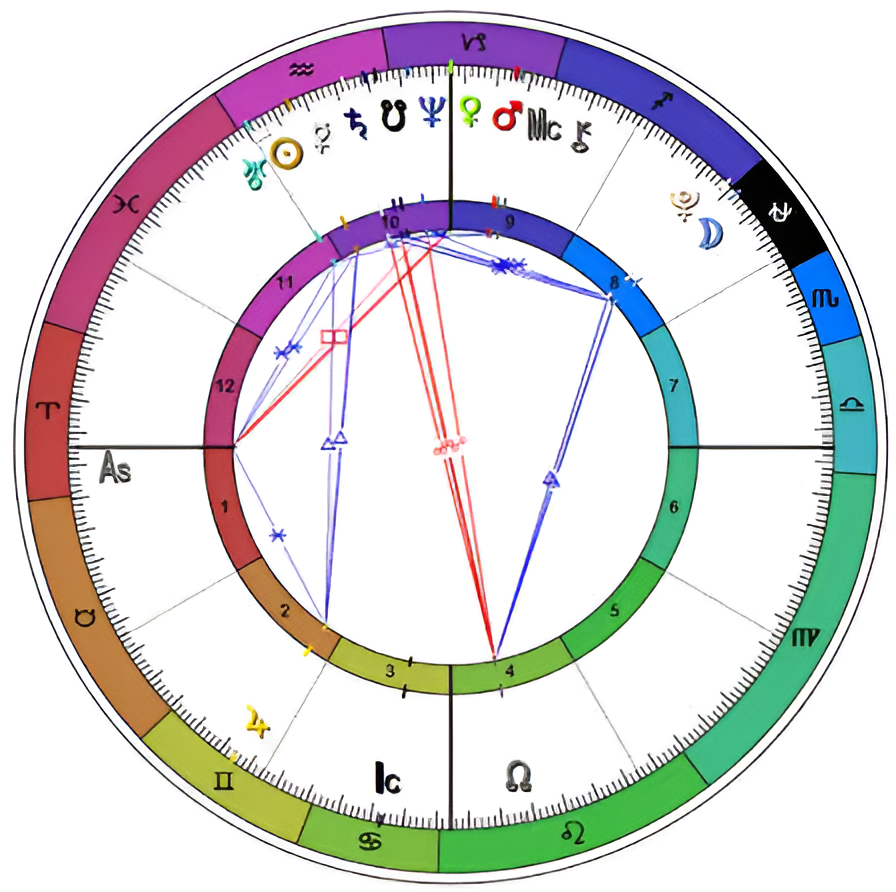
A natal wheel can look confusing at first glance, packed with symbols and no clear starting point. This astrology guide breaks the chart down into seven steps, the same order a professional astrologer follows, making it possible to read a birth chart with real confidence rather than guesswork.
What Is a Birth Chart Calculator Reading?
A birth chart reading process turns raw data into real meaning. The tool handles the math and places every planet and sign. The reading comes after, when a person interprets what those positions say.
The tool works out where the Sun, Moon, and planets sat in the sky at the exact moment of birth. This calculation relies on ephemeris data, the kind maintained by NASA’s JPL Horizons system, the reference astronomers use to track where planets sit at any given moment. The result is also known as a natal chart, since both terms describe the same snapshot of the sky.
The reading itself is a separate task, and it depends on the person doing it rather than the tool. This step involves looking at the astrology chart and working out what each position means for personality, choices, and life path. This kind of tool is one of several types of astrology instruments, alongside horoscopes and other sky tracking pages, but it stands apart because it stays fixed to one exact moment instead of changing day to day.
This difference matters. The math delivers accurate positions. The reading turns those positions into insight, and that second step separates a genuinely useful chart from a page of unread symbols.
What to Gather Before Reading the Results
Three things matter before reading the results: an exact birth time, a birth location, and a reliable reading tool. Missing or wrong details can throw off the rising point and the houses.
- Time of birth: A birth certificate gives the most reliable record. A guess that is off by 30 minutes can already shift that rising point into a different one. The guide to how accurate a chart tool really is covers this in more depth.
- Place of birth: The exact city matters, not just the country, since location shifts the house lines too.
- A reliable tool: Once the platform has the correct date, time, and place, it can generate a result worth reading.
Anyone without an exact birth time can still get a useful reading. The guide to reading a birth chart without an exact time covers what still works and what stays uncertain. Once these three details are correct, the next task is to read your birth chart with confidence.
Step 1, What Are the Sun, Moon, and Rising Signs (the Big Three)?
The Sun, Moon, and Rising sign form the three most important points in a birth chart. This trio is called the Big Three, and together it gives the fastest, clearest picture of a person.
The Sun spot shows core identity and how a person shines. It comes from the birth date alone, so it never changes. The Sun and Moon both count as luminaries, a term for the two brightest lights in the sky.
The Moon spot shows the inner emotional world, the side that shows up in private. It needs a rough birth time to land correctly, since the Moon moves into a new sign every two to three days.
The Rising sign shapes the first impression other people form, and it sets the starting point for every house in the chart. This point needs an exact birth time, since it shifts roughly every two hours. For a deeper breakdown of all three, the guide to the Big Three walks through each one individually.
| Point | What It Shows | What It Needs |
| Sun sign | Core identity and how someone shines | Birth date |
| Moon sign | Emotional world and inner reactions | Birth date, rough time helps |
| Rising sign | First impression, sets house structure | Exact birth time |
Once the Big Three are clear, the rest of the chart builds on this foundation.
Step 2, What Does Each Planet Represent in a Birth Chart?
Each one represents a different part of personality, like communication, love, or drive. Where it sits by sign and house shows how that part of a person plays out in daily life.
The planets split into two groups. The inner ones move fast and shape personal, everyday traits, covering communication, love, and drive. The outer ones move slowly and shape bigger, longer lasting themes, covering growth, responsibility, and generational shifts.
Mercury governs thinking and communication style. Venus shows what a person values and how they love. Mars reveals drive, energy, and how a person takes action. These three move quickly, shifting sign every few weeks.
Jupiter shows where a person grows, takes risks, and finds luck. Saturn points to responsibilities and the lessons a person has to work through. This spot deserves close attention, since beginners often skip past it in favor of flashier bodies, even though Saturn frequently explains more about long term discipline than any other single point in the chart. Jupiter and Saturn both move more slowly and can stay in one sign for a year or more.
The three outermost bodies in the table below move so slowly that each one can stay in one sign for seven years or longer. Because of this, they say less about one person specifically and more about an entire generation born in the same window. Two other points worth checking are the North Node, which points toward a growth path, along with the healing point covered in the same table.
Every symbol on the wheel carries its own name, listed in the table below. Recognizing each one makes it much faster to scan a chart once the shapes become familiar.
| Body | Glyph | What It Represents |
| Sun | ☉ | Core identity |
| Moon | ☽ | Emotions, inner world |
| Mercury | ☿ | Communication, thinking |
| Venus | ♀ | Love, values |
| Mars | ♂ | Drive, action |
| Jupiter | ♃ | Growth, luck |
| Saturn | ♄ | Responsibility, lessons |
| Uranus | ♅ | Change, individuality |
| Neptune | ♆ | Dreams, intuition |
| Pluto | ♇ | Transformation, power |
| North Node | ☊ | Growth path |
| Chiron | ⚷ | Healing, wounds |
Once each body’s meaning is clear, the next step is checking which zodiac sign it falls in.
Step 3, Check the Zodiac Sign Each Planet Sits In
The zodiac sign a body sits in shows how it expresses itself. The body is the “what,” and the sign is the “how” it comes out day to day.
Twelve signs make up the zodiac, and each one carries its own style. A body in Aries acts fast and bold, while the same one in Capricorn works slow and steady toward a goal.
Venus offers a clear example. In Sagittarius, this planet wants freedom and adventure in relationships. The same body in Libra wants balance and harmony instead. The planet stays the same, but the sign changes how it shows up.
Some signs shape how a person handles emotions or plans. Mars in Aquarius can push for change in unusual ways, always chasing a fresh approach. Each sign points to a different part of a person’s world, from love to conflict to work style.
This explains why two people can share the same Sun spot but feel completely different. Their other planets likely sit in different signs, changing the full picture.
Once each planet’s sign is clear, the houses come next, since houses show where in life that energy plays out.
Step 4, What Does Each House Represent?
Each house covers a different part of life, like money, relationships, or career. A body shows what, a sign shows how, and a house shows where that energy plays out.
A birth chart has 12 houses, and each one starts at a line called a cusp. The first house sits at the beginning of the chart, right where the Ascendant sits, and readers often call it the house of self, since it shapes how a person comes across to others.
The houses run counterclockwise around the wheel, not clockwise like a clock face. This trips up a lot of beginners at first, so it helps to remember the order moves backward from what feels natural.
The fourth house sits at the bottom of the chart and covers home and family life. The house near the top of the wheel, listed further down, covers friendships and group goals. Every house works together with the sign and position of any planet inside it, since the two combine to shape the full meaning.
| House | Area of Life |
| 1st House | Self, identity, first impressions |
| 2nd House | Money, values, possessions |
| 3rd House | Communication, siblings |
| 4th House | Home, family |
| 5th House | Creativity, romance |
| 6th House | Work, health |
| 7th House | Partnerships, marriage |
| 8th House | Transformation, shared resources |
| 9th House | Philosophy, travel |
| 10th House | Career, public image |
| 11th House | Friendships, groups |
| 12th House | Spirituality, subconscious |
Three or more planets sitting in the same house forms a stellium, and it usually means that area of life plays a bigger role in a person’s story than the rest. Once the houses are clear, checking the chart ruler comes next.
Step 5, Which Planet Rules the Angles of the Chart?
The body that rules the Ascendant carries the name chart ruler, and it acts as a guide for the whole chart. Its sign, house, and aspects add extra weight to how the entire reading plays out. This step is one of the most underrated parts of a reading, since most beginner guides skip it entirely and stop at the Big Three.
This kind of chart has four angles: the first impression point, the Descendant, the Midheaven, and the IC. This first angle sets the rising point, and each zodiac sign ties to one ruling body. Finding which planet rules that angle identifies the chart ruler.
For example, that same earthy sign on this first angle puts Saturn in charge of the chart. Wherever this body sits, that spot reveals more about the overall path than most other spots do.
This step matters because the chart ruler often explains traits that do not fit the Sun spot alone. A strong, well placed chart ruler tends to support the first impression the angle creates. A weaker one can create some friction between how a person comes across and how they actually feel inside.
Checking the chart ruler’s dignity comes next, since where a body sits can make it stronger or weaker.
Step 6, Where Is Saturn, and Is Any Planet in Its Domicile or Exaltation?
Saturn’s position points to the biggest responsibilities and hardest lessons in a chart, so it is always worth checking first. Beyond this one planet, every body has a sign where it feels strong, called its domicile, and a sign where it feels weak, called its detriment.
Domicile means a body sits in the sign it naturally rules, like Saturn in its own sign. In this spot, the planet works with ease and shows its best qualities clearly.
Exaltation offers a second, even stronger boost. Each body has one sign of exaltation, where it performs at its highest level, going beyond its normal strength. This system traces back to the Ptolemaic tradition in ancient astrology, one of the oldest astrology frameworks still used in modern practice. The opposite spots, detriment and fall, work against a placement, making it harder for that energy to come through smoothly.
| Strength | What It Means |
| Domicile | Sits in its home sign, strong and natural |
| Exaltation | Performs at its best, extra boost |
| Detriment | Sits opposite its home sign, weakened |
| Fall | Sits opposite its exaltation, struggles most |
One lesser known factor also plays a role. Whether someone was born during the day or at night changes which bodies carry more weight in a reading, a concept called sect. A day chart favors the Sun and this ringed planet, while a night chart favors the Moon and Mars. This factor is genuinely underrated, since most free tools never mention it at all.
Checking this strength for each body, starting with the one just covered, shows which parts of a chart carry natural power and which parts may need more effort to work through.
Step 7, Read the Planetary Aspects and the Aspect Grid
An aspect is the angle between two planets, and it shows how those two parts of a chart work together. The grid lists every angle at once, making the strongest connections easy to spot.
Aspects come from measuring the exact degree between two bodies. One flowing angle sits 120 degrees apart and feels smooth and easy, while another sits 60 degrees apart and offers a helpful opportunity. Other angles, like the square and the opposition, create more tension, but that tension often pushes growth rather than blocking it. The table below lists the exact degree and typical range for each one.
Each aspect has a range called an orb, and a planet does not need to sit at the exact degree to count. According to the Astrodienst Astrowiki, a technical reference used across the field, common orbs run wider for major aspects like conjunctions and oppositions, and narrower for smaller ones.
| Aspect | Degree | Common Orb |
| Conjunction | 0° | 9 to 10° |
| Opposition | 180° | 9 to 10° |
| Trine | 120° | 7 to 9° |
| Square | 90° | 7 to 9° |
| Sextile | 60° | 4 to 6° |
Minor aspects use even smaller orbs, and there is a clear reason why. Astrologer Robert Hand explained the logic on The Astrology Podcast, stating that “the minor aspects should have the same orb divided by the harmonic.” In simple terms, a minor angle’s orb shrinks based on how many parts it divides the circle into, so it always stays smaller than a major one. This detail rarely appears in beginner guides, which makes it one of the more underrated technical points in this whole process.
One detail most beginners miss is the difference between an applying and a separating angle. An applying one is still moving closer to exact and feels like it is building. A separating one has already passed exact degree and feels like it is settling or fading.
This layer matters beyond a single chart too. Comparing two people’s charts together produces a relationship focused reading, and the angles between them work the same way as aspects inside one chart. Today’s sky can also be compared to the original positions, showing how current planetary movement connects back to the original chart, a technique covered further down.
Understanding this grid completes every major layer of a reading, planets, signs, houses, and the connections running between them all.
Does a Birth Chart Calculator Show Aspects and Retrograde Planets Automatically?
Most tools show aspects automatically, but retrograde planets are hit or miss. Some flag retrograde motion clearly, while others leave it out completely and expect the reader to check it independently.
A good platform generates the aspect grid the moment it builds the chart. It measures every angle between the bodies and lists them out, so hand math is rarely necessary. This part of the process runs automatically on nearly every tool.
Retrograde motion works differently. A planet appears retrograde when it looks like it is moving backward from Earth’s point of view, even though it never actually reverses course. Some tools mark this clearly next to the symbol. Others skip it entirely, so the spot looks like normal, forward motion when it is not, a gap worth double checking manually.
This matters because a retrograde body in a chart can shift how that energy works, often turning its focus more inward. When a tool does not flag it, checking the motion elsewhere becomes necessary, since missing this detail leaves out real astrological information.
A tool can run every reading and produce an accurate astrology horoscope of positions, but it cannot judge which details matter most for any one person. That part still depends on how carefully each piece gets checked by the reader.
How to Read a Birth Chart Calculator Result, a Worked Example
The fastest way to learn this process is to walk through one example. The sample chart below exists only to show the steps in action, not tied to any real person.
Picture a result with the Sun in Sagittarius, the Moon in Pisces, and a Capricorn Ascendant. Following Step 1, this combination gives an outgoing, adventurous core identity, a sensitive emotional side, and a serious, hardworking first impression. These three components of a birth chart already tell a clear, if partial, story before checking anything else.
Venus comes next, sitting in the same fire sign as the Sun, in the 7th house. By Step 2 and Step 3, this body wants freedom and honesty in love. Placed in the 7th house, from Step 4, that energy shows up directly in partnerships and marriage, since this house governs relationships.
The chart ruler comes after that. Since the first angle sits in that same sign, one particular ringed body takes charge of this chart, following Step 5. That same body happens to sit in its own home sign too, its domicile, so by Step 6 this spot counts as strong. This points to a natural gift for discipline that shapes a big part of this sample person’s style.
The aspects come last, from Step 7. Say the Sun forms a smooth 120 degree angle to this chart ruler. This connection supports steady growth, since the confident, adventurous Sun works well with a strong, well placed ruling body instead of clashing with it.
Put all seven steps together, and this sample chart describes someone adventurous and honest at heart, careful and responsible in how they build a path forward, and someone who finds real ease connecting that discipline to their sense of self. A natal chart adds up to more than a set of separate parts. Reading it step by step, the way this example just did, turns scattered symbols into one clear picture of a person’s role in their own life story, or in this case, the sample story this chart was built to show.
Common Mistakes When Reading a Birth Chart Calculator Result
- Reading one spot alone. A single sign or house rarely tells the full story on its own, and stopping at one spot leaves out the Moon, the rising point, and every other planet.
- Ignoring the chart ruler. Skipping Step 5 means missing a point that often explains traits the Sun alone cannot.
- Treating an estimated birth time as exact. A guessed time can shift the rising point and every house behind it, since each house covers a different part of life and depends on that exact starting point.
- Ignoring aspects completely. Two planets can sit in strong signs on their own, but a tense connection between them still changes how that energy plays out day to day.
Avoiding these four mistakes keeps a reading accurate and complete, instead of built on half the picture.
What Other Charts Can Someone Calculate From Their Birth Data?
Birth data can generate several other charts beyond the natal chart, including the two types covered below, among others. Each one uses the same original details in a different way.
- Solar return chart: built for the exact moment the Sun returns to the same spot it held at birth. Practitioners use this chart to look at themes for the year ahead, since it resets every year on the birthday.
- Synastry charts: compare one chart to another, lining up both sets of bodies side by side to show how two people’s energies interact, a common tool for relationships and compatibility.
- Transit chart: compares where the planets sit right now to where they sat at birth, showing how current events in the sky connect back to the original chart. It updates every single day as the bodies keep moving.
All three start from the same birth data used to build the original chart, just applied in a different way.
Frequently Asked Questions
How do I read my birth chart calculator results?
Read the results in order, starting with the Sun, Moon, and rising point. Then move through each planet, its sign, its house, and the aspects it forms with other bodies. Following this order turns a confusing list of symbols into one clear, connected story.
What are the Sun, Moon, and Rising signs, the Big Three?
These three points make up the most important placements in a birth chart. The Sun shows core identity, the Moon shows emotional world, and the third shows how others form a first impression.
What are the steps to properly read a birth chart?
Properly reading a chart means checking the Big Three first, then each planet’s sign and house, the chart ruler, planetary dignity, and finally the aspects between bodies. Skipping any step leaves part of the story missing, since each layer builds on the one before it.
Can AI or a calculator read a birth chart automatically?
A tool can generate an accurate chart and list every position correctly. It cannot fully read the chart the way a person can, since interpretation involves judgment about how positions work together, something automation only partly handles.
What do the planets, zodiac signs, and houses mean in a birth chart?
A planet shows what part of personality is active, a sign shows how it expresses itself, and a house shows where in life that energy plays out. All three work together to build one complete picture.
How do I calculate my birth chart?
A dedicated tool handles this using an exact birth date, time, and place. It uses real astronomical data to place the Sun, Moon, planets, and houses at the exact moment of birth.
What are planetary aspects and how do they influence a birth chart?
These are the angles between two planets in a chart, like a smooth 120 degree angle or a tenser 90 degree one. They show how those two spots work together, either supporting each other or creating tension that pushes personal growth.
What is the difference between a natal chart and a birth chart?
There is no real difference. Both terms describe the same thing, a snapshot of the sky at the exact moment someone was born, and get used interchangeably to mean the same reading.