Can Two People Have the Same Birth Chart? Comparing Charts Explained
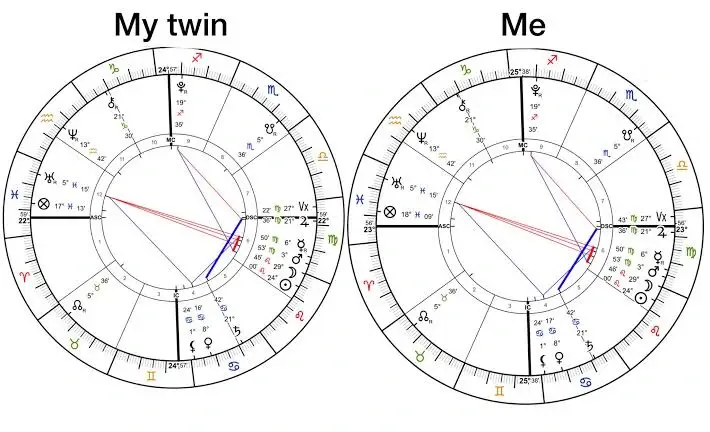
Yes. Identical output can appear when the recorded date, time, location, and calculation settings match. In practice, even a small difference in birth time can change the Ascendant or house placements, while a shared pattern never guarantees the same personality or future.
What makes a chart identical?
An identical result depends on accurate timing, the place, and consistent calculation settings. If the tool uses the same inputs and settings, it should display the same placements. A tool may show small differences when it rounds the time or location.
| Input | Why it matters |
| Date | Sets the day used to calculate the positions of the planets. |
| Recorded time | Affects the eastern horizon point and the division of the houses. |
| Birth location | Latitude and longitude shape the local horizon and houses. |
| Time zone and daylight saving | A wrong clock offset can shift the recorded moment. |
| Sign and house system | Different settings can place the same planet in different signs or houses. |
The Moon travels around Earth in about 27.3 days, so its position changes noticeably from day to day. NASA provides the orbital details in its Moon facts guide. A guide to how the tool works explains the inputs, while these steps for checking chart details cover common entry mistakes.
How often do matching charts occur?
There is no single trustworthy percentage for how often complete sets of placements match. A useful estimate would need a clear definition of “same,” a defined population, accurate records, exact coordinates, and one calculation method.
Sharing a Sun sign is not the same as sharing an entire birth chart. The Moon moves along its apparent path at roughly 13 degrees per day, based on its orbital period, so the Moon sign may change within a few days. The rising point responds more quickly to time and location, and signs do not all rise at the same rate at every latitude. People sharing a calendar day may share many slow moving placements but differ in the Moon, angles, or houses.
Twins, similar charts, and different lives
People born within a few minutes may have very similar planet positions when they arrive close together. Their rising degree, house cusps, or a placement near a sign boundary can still differ. Family roles, health, culture, and individual choices also shape a completely different life.
That distinction matters because charts create symbolic descriptions within this tradition, not controlled proof of cause and effect. Geoffrey Dean and Ivan Kelly’s 2003 paper, “Is Astrology Relevant to Consciousness and Psi?”, summarizes a large test of people whose recorded times differed by less than five minutes and reports that the test found no hint of the similarities the reading predicted. This does not make two people identical or different by itself; it shows why writers should not present a chart reading as a proven prediction.
Astrologers may still treat close timing as meaningful within their tradition, but writers should not present that interpretation as scientific fact.
How does synastry compare two birth charts for relationship compatibility?
Synastry is an astrological comparison of the natal charts of both people. It examines key aspects between planets and the houses where one person’s placements fall in the other person’s houses. The reading describes relationship patterns and possible themes, not proof of anyone’s feelings or future behavior.
Chart compatibility compares two sets of symbolic contacts rather than selecting a partner. This is how two birth charts work together within the method, and a careful reading shows how each person may interpret the same contact. The relationship between two people depends on far more than those symbols. A composite chart works differently: it combines chart midpoints into one symbolic chart for the relationship. Astrologer John Green cautions readers against expecting perfection: “It’s not a key to having perfect relationships.” The conversation about synastry discusses why astrologers examine multiple factors instead of relying on a single sign.
An aspect occurs when a planet in one birth chart forms a measured angle with a planet in the other. In the terminology, planets from one chart aspect planets in the other, so planets in one chart may link to several placements in the other. An astrology chart can therefore provide a map of symbolic contacts. A house overlay adds context by showing the life areas associated with the twelve houses. How can one chart interact with another? Astrologers compare the angles between placements and consider the houses involved; these contacts do not establish whether the pair will stay together.
How to compare two natal charts
A careful process reduces avoidable errors. It starts with reliable birth data, matching settings, and a review of several contacts rather than one headline score.
1. Collect the date of birth, time of birth, and place of birth for both people. If a time remains unknown, a comparison without an exact time can still cover many planet positions, but the reader should not assign a confident rising sign or house reading.
2. Run both records with the same calculation settings. Choose one sign system and one house system, and confirm that the tool handles local time and daylight saving rules correctly.
3. Review the Sun, Moon, Mercury, Venus, and Mars first. Then check the houses only when the recorded time supports that detail.
The site’s free chart tool provides the base chart; a free synastry chart uses both records. A synastry chart calculator generates an overlay and a list of planetary aspects. The method works best with two complete sets of personal details and one consistent set of settings.
Which placements matter most for natal chart compatibility?
Astrologers usually begin with personal placements because these symbols cover identity, feelings, communication, affection, and drive. They may then consider slower moving planets or angles for added context. The Sun, Moon, and Rising sign guide explains the first three placements.
| Placement | Common astrological interpretation |
| Sun | Identity, goals, and direction. |
| Moon | Emotional needs and a sense of comfort. |
| Rising sign | First impressions and outward approach. |
| Mercury | Communication style and the exchange of ideas. |
| Venus | Affection and what a person gives and receives. |
| Mars | Drive, initiative, and ways of handling conflict. |
| Saturn | Boundaries, responsibility, and commitment. |
Astrologers consider it important to look for repeated themes across several contacts. A single aspect needs context; a cluster gives the reader more to interpret. A horoscope column often focuses on one Sun sign, while a full reading goes far beyond that narrow view. A transit compares the current sky with one natal chart; synastry instead studies contacts between two individuals’ natal positions.
How astrologers read synastry aspects
An aspect names the angle between placements in two charts. Astrologers often focus on five major angles:
- Conjunction: the placements sit close together in the sign system.
- Sextile: the placements form an angle of about 60 degrees.
- Square: the placements form an angle of about 90 degrees.
- Trine: the placements form an angle of about 120 degrees.
- Opposition: the placements sit about 180 degrees apart.
No aspect automatically makes a relationship good or bad. An astrologer may read a tense contact as an area for honest discussion rather than as a promise of failure. Readers should examine the planets and angles together, consider the wider pattern, and note areas of harmony as well as areas that may need work.
Zodiac sign compatibility versus a full chart reading
Sun sign pairing can start a conversation, but it cannot decide whether a relationship will work. Zodiac compatibility is only a narrow starting point. No pair of signs automatically points to failure. For example, Aries and Libra sit opposite each other, yet that label alone cannot predict how a couple will communicate or solve problems.
Some traditional astrologers call signs that do not form a major aspect “in aversion.” Signs in a full chart can still connect through other placements. The term describes a technical relationship between signs; it does not prove that two people cannot get along. A common misunderstanding turns sign matching into a pass or fail test, even though a full reading considers more than one placement.
What the Vedic system adds to the comparison
Vedic astrology may use Guna Milan, an eight factor method with a maximum of 36 points, alongside the Moon’s position and other chart factors. Some practitioners also review divisional charts, including the Navamsa, rather than relying on a Western method alone. Karmic language belongs to a spiritual interpretation, not a measurable finding. This overview of Vedic and Western chart methods explains why readers should identify each system and its rules before comparing methods.
Can a compatibility score predict relationship success?
No. A compatibility score summarizes a tool’s chosen rules; it cannot predict whether a relationship will last. Different calculators may weigh aspects, planets, and houses in different ways, so the same pair can receive different numbers.
Dean and Kelly’s review also reported that astrologers did not perform significantly better than chance on basic tasks such as predicting extraversion. That research matters when a high score looks like a guarantee. This symbolic system can offer a way to reflect on relationship dynamics, but it cannot verify trust, consent, emotional health, shared values, or long term behavior. A guide to software accuracy explains what software can calculate, while this article on future prediction covers the limits of predictive claims.
Can someone else calculate another person’s chart?
Yes, when the person agrees. Date, time, and location details can identify someone, so a responsible reader keeps that information private and checks the privacy notice before entering it.
Permission should come first. The person should also know whether the tool stores entries or creates shareable links. No chart can reveal secret thoughts, and a symbolic reading should never replace a direct conversation. People first, chart second.
Frequently asked questions
Can a pair have the exact same chart?
A tool can show identical output when the recorded details and settings match. In real cases, small differences in time or location can change angles or house placements.
Can synastry work without an exact time?
Yes. A reader can compare several planet positions, but an exact time supports a more confident reading of the rising point and houses. Moon based interpretations may also need extra care when the Moon changes signs near the exact moment.
Can astrology identify a soulmate?
No reliable evidence shows that astrology can identify a destined partner. A chart describes themes according to the tradition, rather than proving outcomes. A reading may describe symbolic themes, but it cannot prove that a bond is fated.
What two signs do not go together?
No pair is automatically incompatible. A chart based interpretation considers more placements than the Sun sign, while real relationships also depend on communication, values, and choices.
Can people with incompatible zodiac signs still have a successful relationship?
Yes. Signs do not determine behavior. People with tense symbolic patterns can still build a caring partnership through honest communication, respect, and shared goals.
How reliable is compatibility for predicting relationship success?
It cannot reliably predict success. Planet positions depend on the data entered, but astrologers interpret what those positions mean. A high number does not measure trust or future choices.
What does it mean when two charts share placements except for the rising sign?
The recorded times may differ while many planet positions remain close. The rising point and houses can change more quickly, so the exact time matters for that part of the interpretation.
A reading describes symbolic themes rather than a final verdict. A synastry reading also asks how two people connect and how birth charts interact within this tradition. A whole chart includes more than a sign pairing. Love compatibility remains a question of communication, respect, and shared choices. Even when two birth charts connect closely, the people involved decide how they communicate, set boundaries, and build a relationship.