
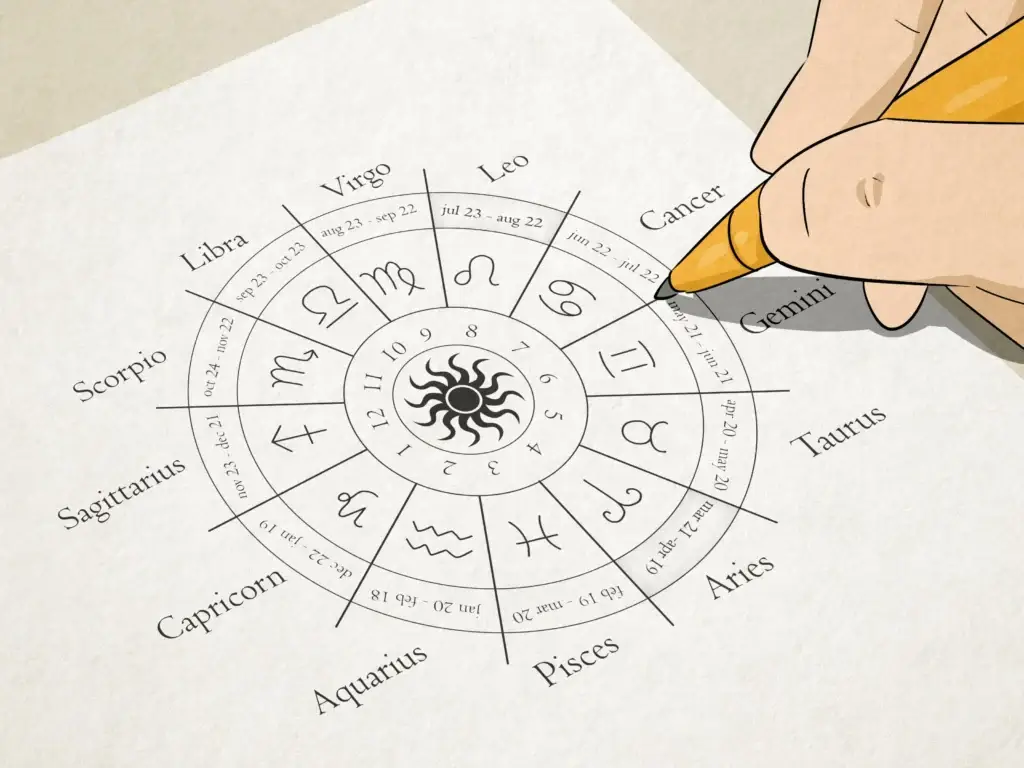
Know How to Calculate a Chart by Hand: An Astrologer’s Guide to Learning Astrology
A person can calculate a birth chart by hand with three references: an ephemeris, a table of houses, and an accurate date, time, and place of birth. The process takes a few hours the first time, and the math stays simple, mostly addition and subtraction. This guide walks through the exact steps an astrologer practices before ever touching software, and where the real value of learning it sits.
What Is a Birth Chart?
A birth chart is a map of where the sun, moon, and planets sat in the sky at the exact moment someone was born. Astrologers also call it a natal chart. It shows each planet’s zodiac placement, its house, and the angle it forms with the other planets.
Software builds this map in seconds, but the process behind it is what this guide teaches. Calculating a chart by hand, sometimes described as learning to cast a natal chart, means working through the same steps with a printed set of reference tables instead of a screen.
Not every astrologer needs to know how to calculate a chart by hand in order to practice astrology, but doing so changes how confidently they can trust and describe a finished chart. Astrologers who skip this step entirely still practice successfully, though many say the manual process is what first made the mechanics of a chart click for them.
What a Person Needs Before Calculating a Chart by Hand
Four references make manual chart calculation possible, and each one covers a different part of the math. Skipping any one of them makes the rest of the process unreliable.
| Reference | What It Does |
| Ephemeris | Lists each planet’s position in the zodiac for every day of the year |
| Atlas | Gives the exact latitude, longitude, and time zone for the birth place |
| Table of houses | Converts the time value from Step 3 and the birth latitude into house cusp positions |
| Scientific calculator | Handles the addition, subtraction, and interpolation between ephemeris entries |
A blank chart wheel and a pencil help too, since the final step is sketching the planets and house lines onto paper. None of these references are hard to find. Printed guides and tables of houses are still sold by astrology publishers, and many students who want to learn how to calculate a chart by hand build a small collection of them over time.
For a source most published tables are built from, NASA’s JPL Horizons system publishes verified planetary position data.
Step 1: Find Planetary Positions With an Ephemeris
An ephemeris shows where each planet sat in the zodiac on a given date. The astrologer looks up the birth date, and this table lists the degree and zodiac position for the sun, moon, and every other planet at a set reference time, usually midnight or noon.
Most planets barely move in a single day, so that entry for the birth date is already close to correct. The moon moves faster, about 12 to 14 degrees a day, so its position needs a small adjustment based on the exact birth time. Astrologers call this adjustment interpolation, and it stays simple math: find the difference between two days’ positions, then scale that difference to the hour of birth.
Step 2: Determine Local Mean Time (LMT)
Local Mean Time (LMT) matters for astrological calculations because every later step in the chart builds on it. Before the astrologer can find the time value in Step 3 or the houses in Step 4, the clock time on the birth certificate has to convert into the true local time at the birth place.
Clock time and true local time rarely match. Time zones follow political lines, not the sun’s actual position, and daylight saving rules push the clock even further from local reality. Converting to LMT means adjusting for the birth place’s exact longitude and confirming the daylight saving rule in effect on that date, using the IANA Time Zone Database for historical accuracy.
A birth certificate that reads 3:45 PM does not automatically mean 3:45 PM local mean time. Skipping this conversion causes the most common error in a hand calculated chart, since every later value inherits the mistake.
Step 3: Find the Sidereal Time at Birth
Sidereal time links Local Mean Time to the ascendant. It measures the earth’s rotation against the stars instead of the sun, and a table of houses reads this value to find the ascendant’s exact degree.
To find this value, the astrologer starts with the figure listed in the ephemeris for that date, then adjusts it using the LMT from Step 2. The final number, written in hours, minutes, and seconds, carries straight into the table of houses in Step 4.
This is the step that trips up most beginners, since it is where astronomical measurement and clock time stop lining up in an obvious way. Once this number is correct, the rest of the chart follows a fairly mechanical order.
Step 4: Find the Ascendant and Houses
The ascendant and house cusps come from combining the time value from Step 3 with the birth place’s latitude inside a table of houses. Looking up the closest latitude and time value in the table returns the exact degree and zodiac placement of each house cusp.
The hemisphere someone was born in changes the direction of this math. Northern hemisphere births and southern hemisphere births read the table of houses differently, since the relationship between latitude and the ascendant flips below the equator. This detail rarely appears in beginner tutorials, but it matters the moment a chart is cast for someone born south of the equator. Astrologers working with clients across both hemispheres treat this as a routine double check, not an edge case.
Not every house cusp holds steady across different house systems. The angular houses stay consistent no matter which house system is used, while several others shift depending on the method chosen. Astrodienst’s Astrowiki documents this comparison across the major house systems in detail.
| House Type | Houses | Stability Across Systems |
| Angular | 1st, 4th, 7th, 10th | Stable in every common house system |
| Commonly disputed | 2nd, 3rd, 5th, 6th, 8th, 9th, 11th, 12th | Cusp position can shift between systems |
When a planet sits close to a house border, some practitioners apply a convention called cuspal promotion. This assigns the planet to the higher numbered house rather than the lower one, since a planet near a cusp already leans toward what comes next. It stays a judgment call, not a fixed rule, and different astrologers apply it differently.
Step 5: Place Each Planet in Its Sign and House
Once the planet positions and house cusps are both worked out, placing each planet becomes simple comparison. The astrologer takes each planet’s zodiac degree from Step 1 and checks which house cusp range it falls between from Step 4.
Each planet’s zodiac position, degree, and house go next to its symbol on the chart wheel. This step adds no new math, just careful matching between two lists already built. For help understanding what these placements mean once the chart is complete, see the guide to reading your birth chart results.
Step 6: Check Essential Dignity
Essential dignity describes how comfortable a planet is in its zodiac placement. A planet in the sign it rules, called domicile, expresses its natural qualities most directly, while a planet in the opposite position, called detriment, works with more friction.
| Dignity | Meaning |
| Domicile | Planet is in the sign it rules; strongest and most natural expression |
| Exaltation | Planet is in a sign where its qualities are amplified |
| Detriment | Planet is in the sign opposite its domicile; expression feels strained |
| Fall | Planet is in the sign opposite its exaltation; qualities feel weakened |
Chart software does not always display this layer clearly, so it stays one of the most overlooked parts of a modern reading. Checking dignity by hand is one of the clearest reasons manual work builds a deeper understanding of a chart than a printout can offer on its own.
Step 7: Determine Sect (Day Chart vs. Night Chart)
Sect is one of the oldest concepts in astrology, and it starts with a simple question: did the sun sit above or below the horizon at birth? A chart where the sun sits above the horizon, in houses 7 through 12, counts as a day chart. A chart where the sun sits below the horizon, in houses 1 through 6, counts as a night chart.
| Chart Type | Sun’s Position | Planets Favored |
| Day chart | Above the horizon (houses 7 to 12) | Sun, Jupiter, Saturn |
| Night chart | Below the horizon (houses 1 to 6) | Moon, Venus, Mars |
Sect changes how strongly certain planets express their nature in a chart. Most modern chart tools skip this traditional technique entirely, which makes it one of the clearest gaps between reading a finished chart and actually calculating one by hand. Astrologers working in the traditional or Hellenistic style consider sect a foundational step, not an optional add on.
Step 8: Read the Aspects (Applying vs. Separating)
Aspects are the angles between two planets, and calculating them by hand means measuring the exact degree difference between each pair. An aspect within its allowed orb, or degree range, counts as active in the chart.
| Aspect | Angle | Typical Orb |
| Conjunction | 0° | Up to 8° |
| Sextile | 60° | Up to 4° |
| Square | 90° | Up to 7° |
| Trine | 120° | Up to 7° |
| Opposition | 180° | Up to 8° |
Beyond the angle itself, every aspect is either applying or separating. An applying aspect still moves closer to exact, since the faster planet has not yet caught up to the slower one. A separating aspect has already passed exact and continues moving apart, which tends to describe something already in motion rather than something still building.
What Kind of Math Is Used in Manual Birth Chart Calculations?
Manual birth chart calculation uses addition, subtraction, and interpolation, not calculus or trigonometry. Every step in this guide uses arithmetic most people already know from school, applied carefully and in the right order.
The difficulty here comes from the number of steps, not the difficulty of any single one. Carrying numbers accurately from one step to the next matters most, since a small mathematical slip early on shifts everything that follows it.
How Long Does It Take to Calculate a Birth Chart by Hand?
A first hand calculated chart usually takes two to four hours, including looking up every value and double checking the math. This stays slow, careful work by design, since each number depends on the one before it.
With practice, the same chart takes far less time. Those preparing for professional certification exams, such as the NCGR PAA certification, often work through dozens of sample charts before the process starts to feel routine, and many treat that repetition as the fastest way to master the process.
Why Learn How to Calculate a Chart by Hand?
Learning how to calculate a birth chart by hand builds a working understanding of astrology that a printout alone cannot teach. It also connects a modern astrologer to a much older tradition, since manual calculation stood as the standard entry point into the practice for centuries, long before software could do it in seconds.
Astrologer Demetra George has described, in a conversation on The Astrology Podcast, how astrology students in the 1970s had to calculate a chart by hand before anything else, since no computer service existed yet to do it for them. She has said the process gave her an “embodied connection” to a chart, something a finished printout never quite matched for her.
Patrick Watson, another practicing astrologer, has written about belonging to the first generation of astrologers who never needed to calculate a chart by hand out of necessity, since chart software already existed by the time he started studying. Astrologers who trained before that shift often worked out and wrote up a full chart reading entirely by hand, sometimes over several hours per client. Watson’s own decision to study the manual method came later, out of curiosity rather than requirement, a position closer to where most people learning astrology today stand.
That kind of connection stays optional for anyone practicing astrology today. Software calculates a chart accurately in seconds, and most working astrologers rely on it every day, but understanding the steps behind that software changes how a person reads the finished result.
Can a Birth Chart Be Calculated Without an Exact Birth Time?
A person can still calculate most of a birth chart without an exact birth time, but not the ascendant and houses. The sun, moon, and other planetary positions only need a birth date, so those parts of the manual process stay accurate even with an estimated time.
For a full breakdown of what still works and what does not, see the guide to birth charts without an exact time.
Can ChatGPT Explain a Birth Chart?
ChatGPT and similar AI tools can describe what a birth chart placement generally means, but they cannot calculate planetary positions or confirm chart accuracy on their own. An AI tool works only from the placements it receives, so any error in those placements carries straight into what it produces.
Understanding the manual process is what lets a person catch a mistake an AI tool would never notice, since the AI has no way to check its own math against an ephemeris. This stays one of the more practical reasons to learn the process, even for someone who plans to keep using chart software for everyday charts.
Where Can a Person Learn to Calculate Charts by Hand?
Most people learn manual calculation from a printed ephemeris and table of houses, paired with a book, a class, or a structured tutorial. Several professional astrology schools still teach this as a required step before anyone moves on to software.
- Books: Printed guides on this process sell through most major astrology publishers and remain the most common starting point for learning to calculate charts by hand.
- Tutorials and video lessons: Many practitioners post free step by step video walkthroughs that cover the exact process outlined in this guide.
- Certification courses: Programs built around exams like the NCGR PAA teach manual calculation as one of several required skills, alongside chart interpretation.
A formal course is not required to start at a basic level. Calculating one full chart by hand, even a single time, is usually enough to understand what chart software is doing behind the scenes.
Common Mistakes in Manual Birth Chart Calculation
Most errors in a hand calculated chart trace back to a handful of repeatable mistakes:
- Skipping the Local Mean Time conversion and using clock time directly, which throws off every step that follows
- Mixing up AM and PM on the birth time, which shifts the whole chart by twelve hours
- Using the wrong hemisphere’s table of houses, which reverses the house math for southern hemisphere births
- Misreading the daily interpolation for the moon, since it moves fast enough to matter within a single day
- Forgetting to check sect, which stays easy to skip since most modern software does not display it clearly
Checking each of these before finishing a chart catches most of the errors a beginner is likely to make. Anyone unsure whether their final chart is trustworthy can also review the guide to birth chart accuracy for a broader look at where accuracy tends to break down.
Frequently Asked Questions
How to manually calculate a birth chart?
Manually calculating a birth chart means using an ephemeris to find each planet’s position, converting the birth time to Local Mean Time and then a star based time figure, then using a table of houses to find the ascendant and house cusps. Each planet is then placed by zodiac position and house, and the aspects between planets get measured last.
How do I find out my entire birth chart?
A free online chart tool shows a complete birth chart fastest, using an accurate birth date, time, and place. Calculating it by hand, using the steps in this guide, produces the same result along with a deeper understanding of how each placement was found.
Can a person calculate a birth chart without knowing the exact birth time?
Yes, for most of the chart. The sun, moon, and other planets only need a birth date, but the ascendant and houses require an exact time, and no method can find them reliably without one.
Can ChatGPT explain my birth chart?
ChatGPT can explain what a given placement generally means, but it cannot calculate planetary positions or confirm they are accurate. It works from the data it receives, so any error in that data carries into what it produces.
What tools or resources are needed to calculate a birth chart manually?
Calculating a birth chart by hand requires an ephemeris, an atlas for birth place coordinates, a table of houses, and a scientific calculator. A blank chart wheel also helps for the final drawing step.
How long does it take to calculate a birth chart by hand?
A first hand calculated chart usually takes two to four hours. The process speeds up with practice, and anyone preparing for professional certification typically calculates many practice charts before it starts to feel routine.
What kind of math is used in manual birth chart calculations?
Manual birth chart calculation uses addition, subtraction, and interpolation, not advanced math like calculus. The difficulty comes from the number of steps and the need for accuracy at each one, not from any single calculation being hard.
Why does Local Mean Time (LMT) matter for astrological calculations?
Local Mean Time converts the clock time on a birth certificate into the true local time at the birth place, accounting for time zones and daylight saving rules. Every later step, including the houses, depends on this number being correct.
What is a birth chart?
A birth chart is a map of where the sun, moon, and planets sat in the sky at the exact moment someone was born. It carries the alternate name natal chart, and it shows each planet’s zodiac placement, house, and its angles to other planets.
What are the reasons to learn how to calculate a chart by hand?
Learning manual calculation builds a working understanding of how a chart forms, connects a modern astrologer to a centuries old tradition, and makes it easier to catch errors in software or AI generated chart descriptions.
Key Takeaways
- A person can calculate a birth chart by hand using an ephemeris, a table of houses, and basic arithmetic.
- Local Mean Time and the star based time figure it produces are the two conversions most beginners get wrong, and both come before the ascendant can be found.
- Essential dignity and sect are two traditional layers most chart tools skip, and both stay easy to check once a chart comes together by hand.
- A first hand calculated chart usually takes two to four hours, and the process gets faster with practice.
- Manual chart work stays optional for practicing astrology today, but it builds an understanding that makes every software generated chart easier to trust.