
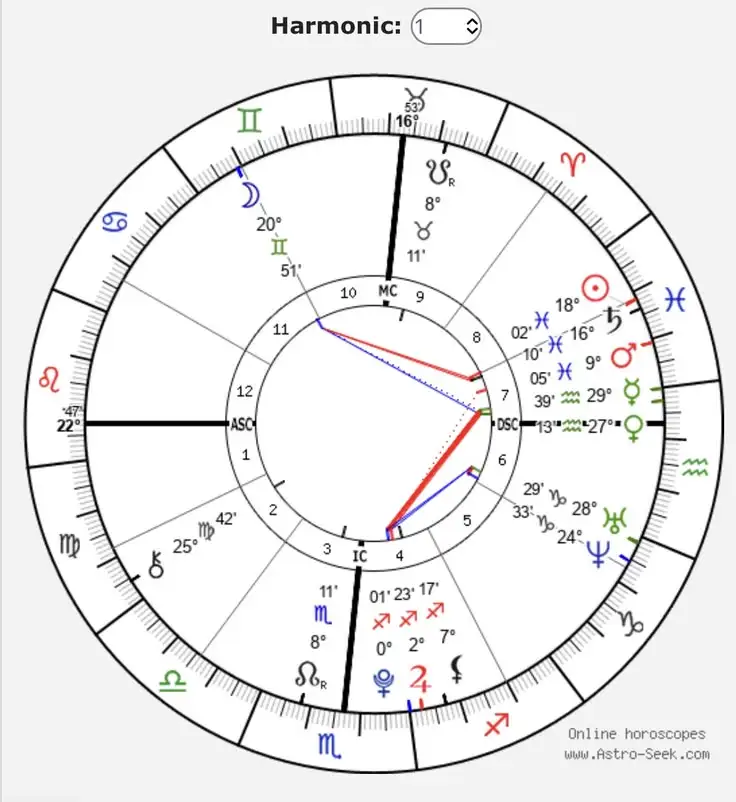
Birth Chart vs Horoscope vs Natal Chart: What’s the Difference
The birth based diagram and the natal chart describe the same birth based diagram, while a horoscope gives a broader forecast tied to a zodiac sign or current sky patterns. A personal chart uses recorded birth information and local timing, so it contains more detail than a general sun sign reading.
What Is a Birth Chart?
The personal diagram is an astrology chart calculated for the recorded date, time, and location connected with a person’s birth. It places the sun, moon, and each planet into a zodiac sign and house so an astrologer can examine the overall pattern. The three core inputs are date of birth, time of birth, and birth location. Local time has particular importance for the rising sign, the ascendant, and house boundaries.
The result can change when the location or time changes, even though many slower planet placements remain stable. A useful calculator should state its zodiac framework and house method. That makes the calculation easier to check and helps readers compare results without treating different systems as if they use identical rules.
What Is a Natal Chart?
A natal chart is another name for a birth chart. The word “natal” identifies placements connected with the moment of birth rather than later sky movement. The label appears often in formal writing, while “birth chart” appears more often in everyday searches. The same data and settings produce the same diagram under the same method.
Natal Chart vs Birth Chart: Is There a Difference?
There is no separate diagram behind the two labels. The difference is mainly language and context.
| Term | Common context | Meaning |
| Birth chart | Everyday and online use | The personal diagram calculated from birth data |
| Natal chart | Formal or technical use | The same birth based diagram |
| Natal placement | Technical discussion | A placement connected with the original birth point |
Birth Chart vs Horoscope: The Important Difference
The personal diagram gives an individual picture, while a general reading normally gives a broad forecast for a sign or theme. Two people can share a sun sign and still have different moon signs, rising sign placements, houses, and aspects. A general forecast can work as a quick daily or weekly reading, but it does not contain the full placement of the planets for one person. A full chart therefore supports a more detailed chart interpretation.
The practical distinction is simple: the natal diagram stays tied to the recorded birth data, while a forecast usually changes with current sky movement or with the sign used for the forecast.
Expert context: NASA states, “Astrology is not the same thing as astronomy.” NASA Space Place
What Are the 12 Houses in a Birth Chart?
The 12 houses divide the chart into areas of life. A house shows where a placement appears, while a zodiac sign describes the style linked to that placement. The 4th house often relates to home and family. The seventh house often relates to close partnerships. The 10th house often relates to career and public role, while the 11th house relates to friends, groups, and wider networks. The house system matters too.
Different approaches can place house boundaries differently, so an astrologer should identify the chosen method rather than present one house system as the only valid option.
What Are the Important Planets in Astrology?
Planets provide the main symbols used in chart reading. The sun and the moon often form the first layer, while Mercury, Venus, Mars, Jupiter, and Saturn add themes related to communication, attraction, action, growth, limits, and responsibility. Uranus, Neptune, and Pluto move slowly and often appear in discussions of generational patterns. The interpretation of each planet depends on its sign, house, and relationships with other placements. celestial aspects add another layer.
A conjunction brings placements together closely by degree, a trine forms a 120 degree relationship, and a sextile forms a 60 degree relationship. Other aspects may also enter a professional reading. Planetary aspects show how placements relate to one another.
Practice note: Professional astrologers may compare several layers before giving a full reading.
What Are the 12 Signs of the Zodiac?
The signs of the zodiac form twelve equal sections in many Western astrology frameworks. Astrologers group them into four elements that offer a simple way to describe recurring styles. Aries fits the fire sign group. Virgo and Capricorn belong to the earth group. Gemini, Libra, and Aquarius belong to the air group. Scorpio fits the water sign group. Scorpio often appears as the water example in this grouping. These categories help organize themes, but a complete reading uses more than one sign.
Readers should distinguish the 12 zodiac signs from constellations. A constellation is an astronomical region, while a particular astrological system defines a sign as a section. NASA explains that astronomy is the scientific study of space and is distinct from astrology.
Aries fits the fire sign group. Virgo fits the earth sign group, and Gemini can serve as an air sign example. Scorpio also appears as a water sign in this four element grouping.
How to Read a Birth Chart
A practical method to read your birth chart starts with the main placements and then moves through signs, houses, and aspects. The purpose is to combine the layers instead of letting one placement define the whole chart. 1. Start with the sun sign, lunar signs, and rising sign or ascendant. 2. Check which zodiac sign holds each planet. 3. Check which house holds each planet. 4. Review aspects between planets and repeated patterns. 5. Combine the placements into a broader chart interpretation.
Related guide: How to read the chart
Which Astrology Birth Chart Is Most Accurate?
No astrology system has a scientifically established accuracy ranking. Western astrology and Vedic astrology use different zodiac frameworks, so the same birth data can produce different sign placements. Western framework commonly uses the tropical zodiac, which anchors signs to seasonal reference points. Indian practice commonly uses a sidereal zodiac that tracks a different astronomical reference. That difference reflects system design, not a simple calculation mistake.
A calculator can be mathematically consistent within its chosen method, but mathematical precision does not prove that an astrological interpretation predicts personality or future events.
Transits: Where Daily Horoscopes Come From
A transit describes the current movement of planets relative to a natal chart or sign framework. Daily forecast writing often uses the sky phase as its starting point, which explains why a forecast changes while a natal chart remains fixed. The present sky movement belongs to the current sky phase layer. The position of the sun at birth belongs to the natal layer. Keeping those meanings separate makes astrology terminology much easier to follow.
How to Create or Find a Birth Chart
A calculator usually asks for calendar reference, local time, and location data. It then calculates sky based placements and, depending on the settings, the ascendant, midheaven, houses, and other points. The exact birth point is especially important when the rising sign, houses, or midheaven matter. Without a precise time, some chart features remain less certain, even though a calculator can still determine many slower moving placements.
The exact moment you were born provides the recorded reference for time sensitive chart features.
A reader looking for a tool can start with a calculator and then review a guide to a birth chart without an exact time.
Related internal resources: Calculator guide | No time guide
Readers who use birth charts often compare the calculated result with later sky movement.
What Are the Components of a Birth Chart?
The core components include planets, the full zodiac cycle, twelve houses, and chart aspects. Some astrologers also include the career angle, north node, and other points. The planet placements provides the base structure. The signs and houses add context, while the aspects describe relationships between placements. The chart is a map used for an interpretive system, not a single label. Many readers use personal charts for reflection, and some describe that process as self understanding.
That personal use should remain separate from claims that scientific research supports the practice.
The calculator returns planetary positions before the interpretive layer begins. The relationship between zodiac signs and houses adds another interpretive layer.
Why Do Birth Date, Birth Time, and Place of Birth Matter?
The calendar reference sets the starting point. recorded time and local location makes the horizon and house calculations more specific. Local time can change the horizon sign and house boundthe ram sign relatively quickly. The local location changes the horizon and the geometric layout used for houses. Slower planet related positions usually move much less over the same short interval. The phrase “moment of your birth” refers to the recorded birth instant.
The solar position and other bodies at that reference point forms the basis for the natal layer.
What Are the Three Types of Astrology?
There is no universal official list limited to three traditions. Western approach, Indian astrology, and Chinese astrology are three widely known systems, but each has its own methods and history. For a clear comparison, the article should name the system before comparing results. Different systems can use different reference points, calculations, and interpretive traditions.
What Two Signs Do Not Go Together?
There is no universally accepted pair of zodiac placements that cannot work together. Compatibility depends on the method and on the individual chart. A simple sign to sign rule can overlook Venus, Mars, moon, ascendant, houses, and aspects. That is why claims about permanent incompatibility are better treated as simplified astrology content rather than a rule that applies to every chart. The relationship between signs plus houses adds another interpretive layer. Readers should not treat one point of the chart as a complete description.
Readers should not treat one chart point as a complete description.
Why the Full Chart Gives More Context
The full chart is most useful when placements are read as a connected pattern. A sign can suggest a theme, but the house shows where that theme appears and aspects can modify how the placement relates to other parts of the chart. Short form general readings often underplay this combined approach. A general forecast may feel relevant while still leaving out important parts of a personal chart.
Evidence and the Limits of Astrological Claims
Authors can present astrology as a cultural or interpretive practice without calling it established science. NASA distinguishes space science from astrology, and the American Psychological Association’s dictionary classifies astrology as a pseudoscience and notes the lack of evidence supporting claims that planet placements determine personality or life events. An E E A T focused article should therefore separate two questions: how astrologers interpret chart symbols, and what scientific research has actually demonstrated. That distinction keeps the explanation useful without overstating certainty.
Research context: The American Psychological Association’s dictionary classifies astrology as a pseudoscience and notes the lack of evidence supporting claims that planet placements determine personality or life events. APA Dictionary
A Note on Calculation Quality
A reliable calculator should document its input method, zodiac framework, and house system. Mathematical precision matters for reproducibility, while interpretive claims require a separate evidence standard.
Key Takeaways
- A natal chart and a natal diagram use different labels for the same birth based diagram.
- A sign forecast usually gives a broad forecast rather than a complete individual reading.
- recorded time and place matter most for the horizon sign, horizon point, and houses.
- Western and Indian methods use different zodiac frameworks.
- A calculator can be precise in its math without proving that an interpretation predicts personality or future events.
Frequently Asked Questions
Are natal chart and birth chart the same?
Yes. Both labels refer to the same birth based diagram when the same data and settings match.
What is the difference between a birth chart, a horoscope, and a natal chart?
The first two terms describe the same personal diagram, while a forecast usually gives a broader forecast tied to a sign, current sky phase, or simplified framework.
Which astrology birth chart is most accurate?
No system has a scientifically established accuracy ranking. Western method and Indian this field use different zodiac references, so their results can differ.
How can someone calculate or find a personal chart?
A calculator normally uses calendar reference, local time, and location data, then calculates placements, houses, and related points.
How does someone read a chart?
A reader normally checks each planet by sign and house, then reviews aspects and the overall pattern.
Does an exact recorded time matter for a natal chart?
An exact time is not required for every feature, but it is important for the rising placement, horizon point, career angle, and houses.
Are sun sign forecasts useful?
They can serve as broad, general interest readings, but they do not replace a full chart for detailed interpretation.
What are the components of a the chart?
Common components include planets, signs, houses, aspects, the 10th house angle, and the north node.
How do Western and Indian systems differ?
Western framework commonly uses a tropical zodiac, while Indian chart work generally uses a sidereal zodiac.