
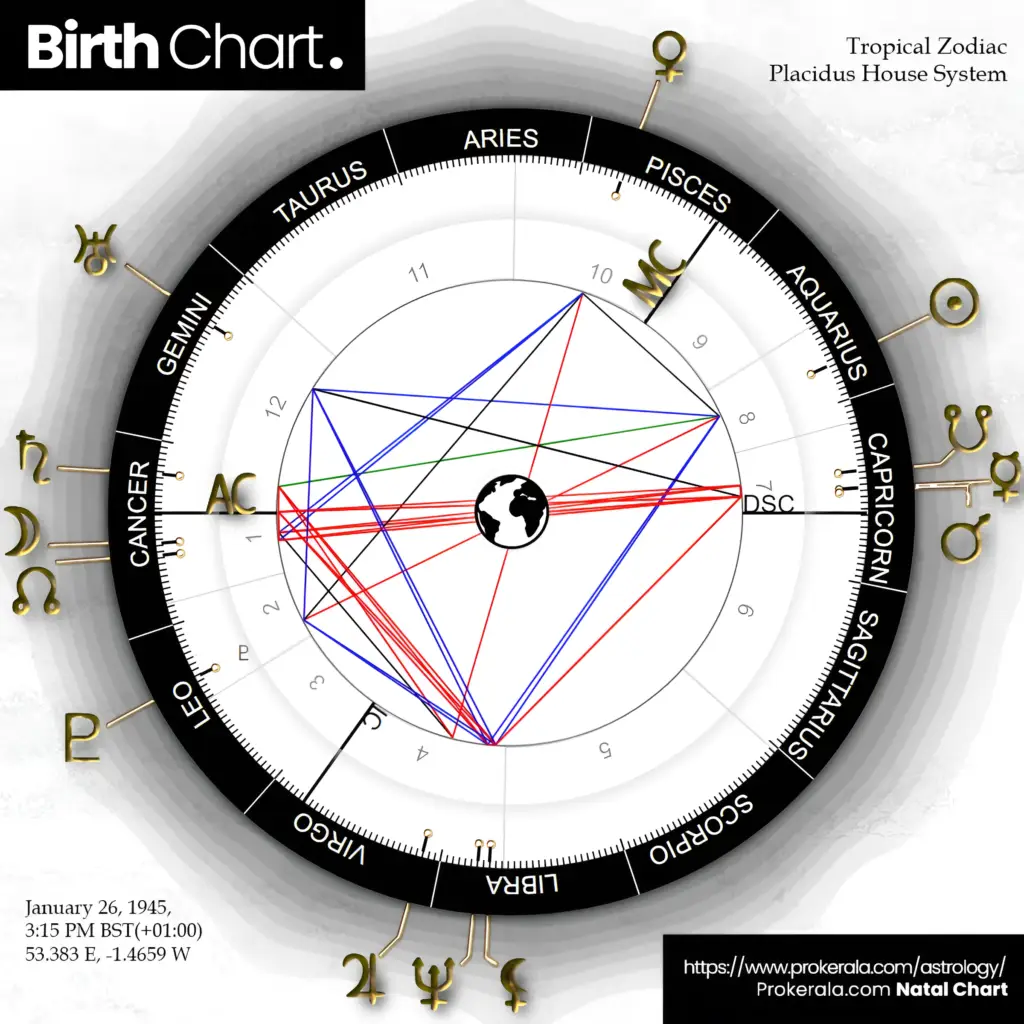
Free Birth Chart Calculator: A Natal Chart & Astrology Reading Guide by a Professional Astrologer (House System Explained)
A birth chart calculator is accurate for the math it performs. It places each planet, sign, and house line using verified astronomical data, the same method professional astrologers use. Accuracy can slip when the input is wrong, since an inaccurate birth time or the wrong location will shift the rising sign and house positions. The chart itself stays precise, and birth details are what make or break the final result.
What Does “Accurate” Actually Mean for a Birth Chart?
Accuracy has two separate parts. The first is the math itself, the exact process that places every planet, sign, and house line based on birth date, time, and location. The second is what those positions suggest about a person’s life, personality, and choices. A tool can get the math perfectly right even when this second layer still feels off, since reading a chart is symbolic rather than mathematical.
Think of it like a map. The coordinates on a map stay fixed and don’t shift. How someone reads that map, chooses a route, or connects it to their own life is a separate skill entirely.
| Type | What It Covers | What Affects It |
| The math | Exact planet, sign, and house position | Birth date, birth time, birth location |
| The read | What those positions suggest for a person | The astrologer, source, or style of the read |
Most people asking whether a birth chart tool is accurate are really asking about the math. On that front, most modern tools rely on the same verified astronomical data that professional astrologers use in daily practice. A birth chart is sometimes called a natal chart, and both terms describe the same snapshot of the sky at birth, not a moving transit that shifts day to day.
What a Birth Chart Tool Gets Right Without Any Guesswork
Most of a birth chart doesn’t depend on knowing the exact birth time. The Sun only needs a birth date, and that stays locked in no matter what time someone was born. Most other points in the sky work the same way.
This is good news for anyone unsure about their exact time of birth. A large part of a chart is already solid before time even enters the picture.
The table below breaks down what each part actually needs:
| Chart Element | What It Needs | How Often It Changes |
| Sun sign | Birth date only | Once a year, around the same few days |
| Moon | Birth date, rough time helps | Every 2 to 3 days |
| Other points | Birth date only | Every few weeks to years, depending on which one |
| Rising sign | Exact birth time required | Roughly every 2 hours |
| House line | Exact birth time required | Shifts throughout the day |
The Sun, and most planet positions, are set the moment someone is born on a given date. No tool can get these wrong if the birth date is correct.
The Moon moves faster across the sky, so it needs at least a rough time of day to land correctly. It can still shift signs within the same day for anyone born close to a change.
The real accuracy test comes down to two things: the rising sign and the houses. Both depend entirely on the exact minute of birth, which is why every birth chart tool asks for a precise time of birth.
Why Birth Time Is the Biggest Accuracy Variable
Birth time controls two of the most personal parts of a chart: the rising sign and the houses. Even a small mistake in the recorded time can shift both, sometimes enough to change an entire rising sign.
Here’s a simple rule of thumb. Earth completes a full spin in about 24 hours, so on average the rising sign moves roughly 1 degree every 4 minutes. Since each sign covers 30 degrees, a birth time that’s off by an hour or more can push it into a completely different sign.
This is why two people born in the same hospital, on the same day, can end up with different charts. Even twins born minutes apart can carry different rising signs if enough time passed between births.
| Birth Time Error | Typical Effect on the Chart |
| A few minutes off | Small shift in exact degree, sign usually stays the same |
| 15 to 30 minutes off | Rising sign degree shifts noticeably, sign may change near a border |
| 1 hour or more off | Rising sign can change completely, houses shift significantly |
| No birth time at all | Rising sign and houses can’t be worked out with confidence |
Here’s something most people never think about. Hospital birth certificates often round the recorded time to the nearest 15 minutes. A time listed as “6:00 AM” might really mean anywhere between 5:45 and 6:15, and that gap alone can be enough to shift the rising sign.
Anyone looking for accuracy above all else should start with the birth certificate rather than memory or a family estimate, since a few minutes of difference at the exact moment someone was born can matter more than most people expect.
Why Location Matters as Much as Time
Birth location works together with birth time to set the rising sign and houses. Even with an exact time, the wrong city or the wrong time zone can throw off an entire chart.
One common mistake is entering a city with the same name in the wrong place. Cities like Springfield or Cambridge exist in many countries and states, and picking the wrong one can shift results without anyone noticing.
Time zones cause similar problems, especially for older birth dates. Daylight saving rules have changed many times over the decades. The Uniform Time Act of 1966 was the law that finally standardized daylight saving dates across the United States, decades after individual states and cities had already been keeping their own local rules for years.
Astrological software typically pulls historical time zone data from the IANA Time Zone Database, the reference most tools use to work out what time it actually was in a given city on a given date. Here’s what’s worth double checking before trusting a set of results:
| What to Check | Why It Matters |
| City name and country or state | Same named cities exist worldwide and can shift a chart |
| Time zone for the birth year | Rules have changed throughout history, especially before 1970 |
| Daylight saving time | Some regions used it inconsistently before national standardization |
| Coordinates | Small location errors can shift a house line slightly |
This is a detail most people never think to check, but it can matter as much as getting the birth time right. If results look off, location settings are worth reviewing before assuming the math itself is wrong.
Why Two Tools Can Give Different Results
Anyone who has tried more than one birth chart tool may have noticed the results don’t always match. This doesn’t usually mean one is wrong. It usually means each one made a different choice behind the scenes.
Most differences come down to settings, not mistakes. Every tool has to choose a house system, a way of measuring the sky, and a way of handling time zone data, and different tools don’t always choose the same way.
| What Differs | Why It Happens | How Big the Difference Usually Is |
| House system | Some use an older, time based method, others use Whole Sign or a different approach | Can shift which house a planet falls in |
| Sky measurement | Two traditions measure the sky differently | About a 24 degree gap, can shift signs entirely |
| Time zone handling | Older birth dates rely on historical daylight saving records | Can shift birth time by an hour if handled incorrectly |
Which system a tool uses to divide the houses has the biggest impact on results. The older, time based approach is the one most people run into as the default today, while Whole Sign, one of astrology’s oldest methods, has come back into wide use over the last two decades. Neither is more correct, they simply divide a chart differently.
The Western and Vedic traditions measure the sky itself in two different ways, and the gap between them is large enough to shift where the Sun lands in some cases. Studying astrology seriously usually means running into this debate sooner or later, since neither camp considers itself wrong.
Worth remembering: a difference between two tools is almost never a sign that something is broken. It’s usually just two systems making different, valid choices about how to read the sky, not unlike how two working clocks can show different times if they’re set to different zones.
Is Vedic or Western Astrology More Accurate?
Neither is more accurate than the other. Vedic astrology and Western astrology measure the sky from two different starting points, so they’re built to answer different questions rather than compete on correctness.
Western astrology uses the tropical zodiac, based on the seasons. It starts each year at the spring equinox, so a sun sign always lines up with the same time of year no matter what.
The Vedic tradition uses a star based system instead, tracking the actual position of the stars. Because stars shift very slowly over time, that star based zodiac has drifted from the seasonal one by about 24 degrees today.
| System | Zodiac Type | Based On |
| Western astrology | Seasonal | The seasons and the sun’s position relative to Earth |
| Vedic astrology | Star based (sidereal) | The actual position of the stars in the sky |
This gap is large enough that the Sun can land in a different sign under each system. Someone born in early Aquarius under the seasonal system might land in late Capricorn under the star based one, and both readings are correct for their own tradition.
The Vedic tradition also carries its own philosophy, including ideas about karma and past life patterns, that Western astrology doesn’t typically address. A completely separate framework, Human Design, blends astrology with other systems entirely and follows its own rules. Choosing between any of these isn’t about accuracy. It comes down to which tradition someone wants to follow, since each is internally consistent and widely practiced.
Which House System Is Most Accurate?
No single method for dividing houses is more accurate than another. Each one uses a different approach, so they’re built on different logic rather than different levels of correctness.
The time based method most people encounter today divides a chart based on time itself, which makes house lines fall unevenly, since some houses end up wider than others depending on birth location.
Whole Sign is one of the oldest ways to divide a chart, dating back to ancient astrology. It’s simpler by design: each house matches exactly one zodiac sign, so every house stays the same size no matter where someone was born.
| Approach | How It Divides a Chart | Works Best For |
| Time based (Placidus) | Houses can be different sizes | Births closer to the equator or mid latitudes |
| Whole Sign | Each house equals one full sign | Any location, including far north or south |
There’s a location based reason this matters more than people realize. According to a long running technical discussion among astrologers on the Skyscript astrology forum, the time based system becomes mathematically undefined for parts of the sky near the Arctic and Antarctic circles, since it depends on a point rising and setting within a day, something that doesn’t happen for weeks at a time near the poles. Whole Sign doesn’t run into this problem, since it never depends on that kind of time based division.
Robert Hand, a professional astrologer who has written extensively on the history of house division, has spoken publicly about growing frustrated with the results he got from the quadrant based approach he was originally trained on. “I couldn’t make them work,” he has said of that early experience, in a conversation on The Astrology Podcast, before later moving toward the Whole Sign house system after studying its use in ancient practice. Many astrologers have made a similar shift over the past two decades, and Whole Sign is now taught almost as often as the older method.
Anyone with an uncertain birth time may find the equal sign method the safer pick. Since it doesn’t rely on precise timing, small birth time errors are less likely to change house positions.
Free vs. Paid Birth Chart Tools: Is There a Real Accuracy Gap?
There’s usually no real accuracy gap. A free chart and a paid one typically pull from the same kind of astronomical data to work out sky and house positions, so the underlying math doesn’t change based on price.
What actually differs is everything around the math itself. Paid tools often add deeper reports, extra detail on compatibility or life path questions, or a more polished design, but none of that changes whether the rising sign or house position is correct.
| What Someone Pays For | Does It Affect Accuracy? |
| Basic chart math | No, the math is the same across most tools |
| Depth of written reports | No, this is about content, not accuracy |
| Design, layout, and extra features | No, this is about experience, not accuracy |
| Ads or account requirements | No, this is a business choice, not a math issue |
Here’s something worth knowing that most people never check. A free birth chart tool can be just as accurate as a paid one, as long as it uses a real ephemeris, the dataset that tracks sky positions across time. Price doesn’t guarantee better math, it usually just buys more content built around the results.
Anyone who wants to test this can enter the same birth details into two different tools, one free and one paid. If both draw on correct astronomical data, the core positions should land closely, even if the reports and design look completely different.
How to Read Results With More Confidence
Nobody needs to be an expert to trust their results. A few quick checks can show whether a chart looks solid or whether something might be off.
Start with the birth time. Anyone working from an exact time on a birth certificate can trust the rising sign and houses. Anyone working from a guess or a rough estimate should treat those two positions with more caution than the rest of the chart.
Next, check which method a tool used to divide the houses. Most sites list this somewhere near the results or in the settings, and knowing whether it’s the older time based approach, the equal sign method, or something else explains why houses might look different from a chart built somewhere else.
| Check This | Why It Helps |
| Was the birth time exact or estimated? | Shows how much to trust the rising sign and houses |
| Which method did the tool use to divide the houses? | Explains differences between tools |
| Which zodiac type did the tool use? | Explains sign differences between Western and Vedic charts |
| Was the birth location entered correctly? | Rules out a common source of error |
A number of long running, well known sites all default to different settings, which is exactly why side by side comparisons so often look like a mismatch. The section below breaks down how four of the most visited ones actually differ.
Comparing a Western chart to a Vedic one, or one house dividing method to another, will almost always show gaps that have nothing to do with accuracy. The goal isn’t finding a “perfect” tool. It’s understanding what the results are actually saying, so the reading carries real insight instead of confusion.
How Do Other Popular Calculators Compare?
A handful of sites come up constantly when people compare results. None of them is more accurate than another, they just ship with different starting settings, and knowing those defaults explains most of the mismatches people run into.
| Site | Default Approach | Default Sky Type | Worth Knowing |
| Astro.com (Astrodienst) | Placidus | Western | Offers a large “Extended Chart Selection” menu covering dozens of alternate house methods and a separate sidereal option |
| Cafe Astrology | Placidus | Western | Runs entirely separate report pages for several alternate house methods, plus a separate Vedic tool |
| Astrolabe | Placidus | Western | Notes on its own site that many American practitioners prefer Koch instead, and that more than 30 other methods exist |
| Astro-Seek | Placidus (switchable) | Western | Built around a dedicated comparison tool that lines up Placidus against several other house methods side by side |
The pattern repeats across all four: Placidus is the shared starting point, the Western tradition is the default sky measurement, and every site lets a visitor switch to an alternate house method or a Vedic setting if they want it. Two results only look wrong next to each other when they’re compared without first matching these settings.
What’s Included in a Free Birth Chart Reading
A good no cost chart covers more than most people expect, and nobody needs to pay anything to get a full breakdown of the sky, houses, and key positions involved.
At the core is the Big Three: Sun, Moon, and rising sign. Together, these explain the signs and planets that shape a person’s personality and how they show up in the world (see our full breakdown of the Big Three for more on each one).
Beyond the Big Three, a complete free reading usually includes:
| Included in a Free Reading | What It Shows |
| All planet positions | Where each one sits, by sign and house |
| House positions | Which life areas each one touches, including career and vocation |
| Basic aspects | How these points interact with each other |
| Points like the midheaven or Chiron | Career direction, or areas tied to healing and growth |
| Retrograde motion | Whether a body appears to move backward from Earth’s viewpoint |
This is enough for a complete beginner who wants to learn astrology to learn how to read a first chart, without needing an astrologer or other practitioner sitting alongside them. Get a free birth chart reading with nothing more than a birth date, birth time, and birth location, and the results will already give a fairly complete picture.
Accuracy Isn’t the Same as Certainty
A birth chart’s math can come out perfectly accurate and still leave room for different reads. Accuracy means the math is correct. Certainty is something else entirely, since chart interpretation always involves some amount of judgment.
Two astrologers can look at the same accurate astrology chart and explain it in slightly different ways. This doesn’t mean either one is wrong, it just means no fixed answer exists the way it would for a math problem. Some modern approaches, including Jungian influenced psychological astrology, treat a chart as a symbolic mirror read holistically rather than a literal prediction of events.
This is where astrology moves from raw numbers into something more personal. Positions in the sky are fixed facts, but how they resonate with someone’s actual life is something to explore through intuition and reflection, not something a tool can hand over automatically. There’s real meaning in that process, even if a tool can’t calculate it the way it calculates the chart itself.
A few things worth keeping in mind about any chart:
- Positions won’t change no matter who reads them
- Explanations can vary between sources, and that’s normal
- A chart works best as a tool for insight, not a tool for manifestation of guaranteed outcomes
- The most useful chart is one that helps someone reflect, not one that claims certainty
A birth chart is, in a sense, a cosmic snapshot, a small piece of the wider cosmos captured at one exact moment. An accurate birth chart tool provides a solid, factual foundation. What gets built from that foundation, through reflection and study, is where astrology becomes genuinely useful rather than just a list of numbers.
Frequently Asked Questions
How reliable and accurate are birth charts and astrology apps?
Birth charts are reliable for the math, since they rely on real astronomical data to place each planet and house. Most astrology apps and horoscope sites pull from the same type of verified data, so the numbers behind a chart are trustworthy. Reliability can drop at the read itself, since different apps describe the same chart in different ways.
What factors influence the accuracy of astrology readings?
Birth date, birth time, and birth location are the three biggest factors. Getting any of these wrong, even by a few minutes or the wrong city, can shift the rising sign and houses. The method a tool uses to divide the houses, and how it measures the sky, both affect results. None of these factors make a chart “wrong,” they just need correct entry from the start.
What if someone doesn’t know their birth time for a birth chart?
A useful chart is still possible without an exact birth time. The Sun and most planet positions stay accurate, since they only depend on birth date. The rising sign and houses are the two positions that need an exact time, so it makes sense to treat those as estimates instead. For a deeper breakdown of what’s possible without a birth time, the Big Three guide for readers without an exact birth time walks through it step by step.
Do astrologers agree with each other on interpretations?
Not always, and that’s normal. Two astrologers can look at the same accurate chart and highlight different themes or offer slightly different reads. This happens because reading a chart involves judgment, not just math. It doesn’t mean one is right and the other wrong, it just means room exists for perspective.
Is astrology backed by science?
Astrology isn’t supported by mainstream scientific evidence as a predictive system, and most researchers treat it as a belief system rather than a science. That said, the astronomical data behind a birth chart, planet positions and house lines, is real and verifiable. The debate around astrology centers on interpretation and prediction, not on whether the underlying numbers are correct.
Key Takeaways
A birth chart calculator is accurate for the calculation it performs, using real astronomical data to place each planet, sign, and house cusp. Results can vary based on birth time, birth location, and the settings a given tool uses, like which method divides the houses or which measuring approach it follows. None of these differences mean something is broken, they simply reflect different valid choices. Trust the numbers behind the ascendant and every other placement, and treat what follows as a guide for self reflection rather than a fixed answer.